설치
npm install -g @deepseek-ai/dsh이 명령은 GitHub 저장소 주소에서 생성됩니다. 실행 전에 업스트림 README와 소스를 검토하고 재현성이 필요하면 release 또는 commit을 고정하세요.
README
유지 관리자가 작성한 문서 스냅샷입니다.
dsh-model-router
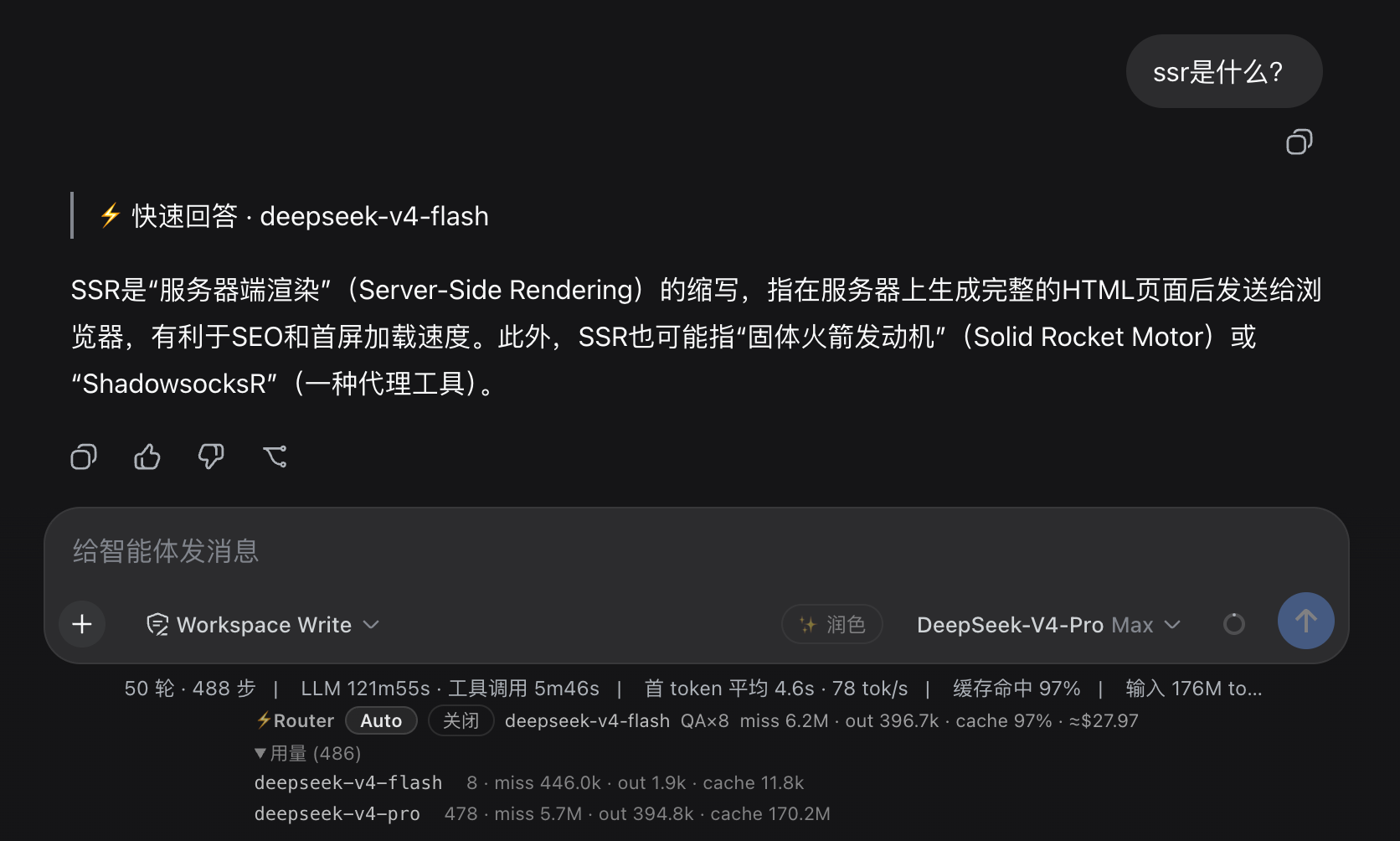
Model Router & Cost Optimizer for DeepSeek Harness (dsh). Answers simple questions directly on the cheap model (zero prefix, no cache tax), degrades gracefully on transient provider failures, and shows live per-session token / cache-hit / cost figures right under the composer.
The harness is in developer preview and iterates quickly — expect compatibility-breaking changes.
中文说明见 README.zh.md。
Features
- Cheap-model judge routing — clearly heavy work (strong keywords / long payloads) goes straight to the main model with zero added latency. Everything else is decided by a zero-prefix flash judge call (
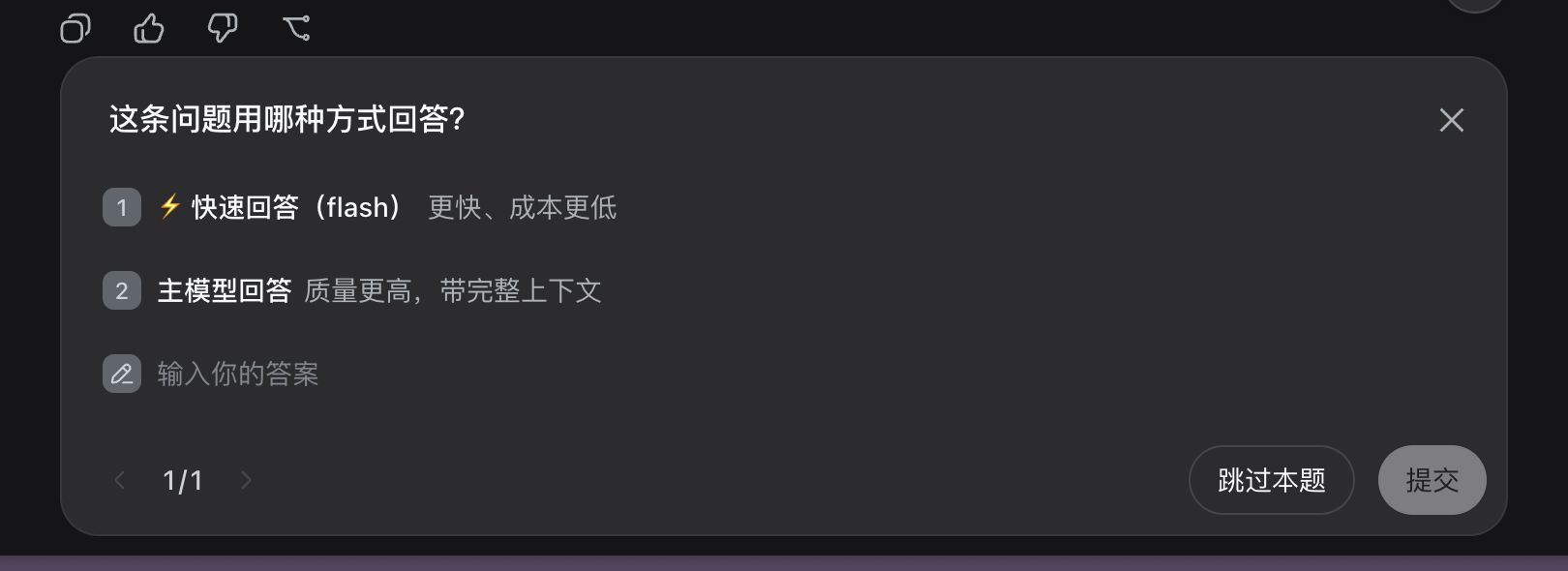
SIMPLE/AGENTIC, one word, 64-token cap, thinking off). The judge also sees the last assistant reply, so context-dependent follow-ups (它 / 这个 / 继续 …) are never misrouted to a context-free answer. - Ask before quick-answering — in auto mode, every SIMPLE hit asks the user through the built-in question UI: ⚡ 快速回答(flash) or 主模型回答. Choosing the main model (or dismissing the question) takes the normal flow; subagent sessions fall back automatically. The question text follows the request language.
- Direct quick-answer — when the user picks the quick option (or a quick answer is otherwise produced), the router rejects the step, runs a zero-prefix one-shot stream on the cheap model (no cache-miss tax), and writes the question + answer straight into the session log inside a step envelope — the user sees an ordinary Q&A exchange prefixed with a
⚡ 快速回答 / Quick answer · <model>marker (matched to the question language), the main model never runs for it, and no subagent sessions, relay cards, or toasts are created. The main session's model and prefix cache are never touched. - Auto / off toggle — the dock panel and
/router auto|off(plus theroute_modeltool) simply enable or disable quick-answering for the session. There is no per-request model flipping to configure. - Automatic fallback — transient failures (
RATE_LIMIT,SERVER,TIMEOUT,EMPTY_RESPONSE) degrade the turn to the cheap model and retry once; anything else delegates to the provider's own retry policy. - Real usage metering — a session projection folds the durable log: real adapter token usage (input / output / cache read / cache write / reasoning), per-model breakdown, and estimated cost from a model-class price table. Projection-based, so the numbers are replay-safe and survive cold sessions.
- Composer dock panel (i18n zh/en) — Auto / 关闭 toggle, current model,
miss/out/cache%/≈$line, aQA×Nquick-answer counter (with a brief inline highlight on each direct answer), and a per-model usage breakdown. Reactively driven byuseProjection; the toggle reuses the built-incommandsremote — no custom wire protocol. UI strings are localized through the harnesslocaleservice.
Screenshots
Quick answers land as ordinary chat messages with a ⚡ 快速回答 / Quick answer marker:
The router dock under the composer — Auto / 关闭 toggle, current model, live token / cache-hit / cost figures, and the per-model usage breakdown:
Install
Prerequisites
The dsh CLI must be on your PATH. If you only ever ran the harness through npx, dsh is not installed and you will get zsh: command not found: dsh — install it globally first:
npm install -g @deepseek-ai/dsh
pnpm add -g @deepseek-ai/dsh also works if your pnpm global bin dir is on PATH (otherwise pnpm asks you to run pnpm setup first). Alternatively skip the global install and prefix the commands below with npx @deepseek-ai/dsh ….
Add the bundle
# 1. add the bundle to your web profile (pnpm-backed; the built lib/ artifacts
#    are committed in this repo, so no build script runs at install time).
#    Prefer a release tag (#v0.7.2); #main tracks the latest commit.
dsh plugin --profile web add "github:tianji-qingtian/dsh-model-router#v0.7.2"

# 2. restart the harness with that profile — `add` only edits the profile
#    files; a running instance does not hot-load the new bundle
dsh --profile web
After the restart the ⚡Router panel appears under the composer in the Web UI, and the /router command plus the route_model tool are registered once the host half loads. Verify under Settings → Plugins that dsh-model-router is listed.
A dynamic (session-only) prototype with the same name may already be running inside one session; it is unrelated to the installed bundle and disappears with the harness process.
How it works
| Piece | Mechanism |
|---|---|
| Step classification | agent/pre-step waterfall — strong-keyword fast path, then a zero-prefix flash judge call (SIMPLE / AGENTIC) with the last assistant reply for reference detection |
| Quick answers | agent/pre-step rejects the step after a zero-prefix llm.stream on the cheap model; the question + answer are appended to the session log (user/message + a forged step/start…assistant/message…step/end envelope) — the main model never runs |
| Drift healing | agent/request restores the agent's configured model whenever no routing decision applies (a forged header or stale persisted header never sticks) |
| Failure fallback | agent/request-error waterfall — returns { kind: 'retry' } after flagging the turn; the retry re-enters agent/request and lands on the cheap model |
| Stats | sessionProjections.register('modelRouter', …) folded over request/header, command/run, and assistant/message events (usage + mrtr-ans- quick answers) |
| Dock UI | conversation.composer.dock slot + standard useProjection prop + locale service for zh/en text |
| Manual control | `/router auto |
The cheap/strong model pair is discovered at runtime from the provider's catalog (llm.listModels): ids matching flash|chat|mini|turbo|haiku|lite|air|nano are cheap candidates, pro|reasoner|opus|sonnet|max|ultra|premium|r1 are strong. With the stock DeepSeek adapter that is deepseek-v4-flash ↔ deepseek-v4-pro.
Cost estimates
The price table is a model-class estimate (USD per 1M tokens) living at the top of src/index.js:
const PRICE_TABLE = [
  { test: CHEAP_RE, input: 0.27, output: 1.10, cacheHit: 0.07 },
  { test: STRONG_RE, input: 0.55, output: 2.19, cacheHit: 0.14 },
]
Edit it to match your account's actual pricing; the panel always labels the number with ≈. Cache hits are billed at the cache-hit price, not the input price.
Counting semantics: harness TokenUsage fields are disjoint — inputTokens already excludes cache reads (DeepSeek reports prompt_tokens = hit + miss; the adapter subtracts hits out). The panel therefore shows miss … · cache N% where the hit rate is hit / (hit + miss); a healthy long conversation typically sits in the high 90s.
Known limitations
- Routing state is split: the auto/off mode is durable (folded by the projection from the session's
command/runevents, so it survives restarts), while the transient-failure degradation flag is process-local and resets with the harness. useProjection-driven stats reflect the whole session log — history recorded before installation is included, which is intentional.- Direct quick answers write a forged step envelope (plus a
request/headerfor attribution) into the session log. This satisfies the current session invariants (the step is appended before the real step starts), but it is the most harness-coupled part of the plugin — worth re-checking after harness upgrades.
License
MIT
저장소 정보
- 언어
- JavaScript
- 라이선스
- MIT
- 최신 릴리스
- v0.8.1
- 마지막 업데이트
- 2026. 8. 14. 오전 8:06
신중하게 설치하기
소스 코드, 권한, 수명 주기 스크립트, 의존성 및 네트워크 접근을 검토하고 신뢰하지 않는 플러그인은 격리 환경에서 테스트하세요.