설치
npx -y @deepseek-ai/dsh plugin --profile web add github:Totoro-qaq/Cobsidian이 설치 명령은 GitHub 저장소 주소에서 생성된 확인되지 않은 시작점입니다.
README
유지 관리자가 작성한 문서 스냅샷입니다.
Cobsidian
English · 简体中文
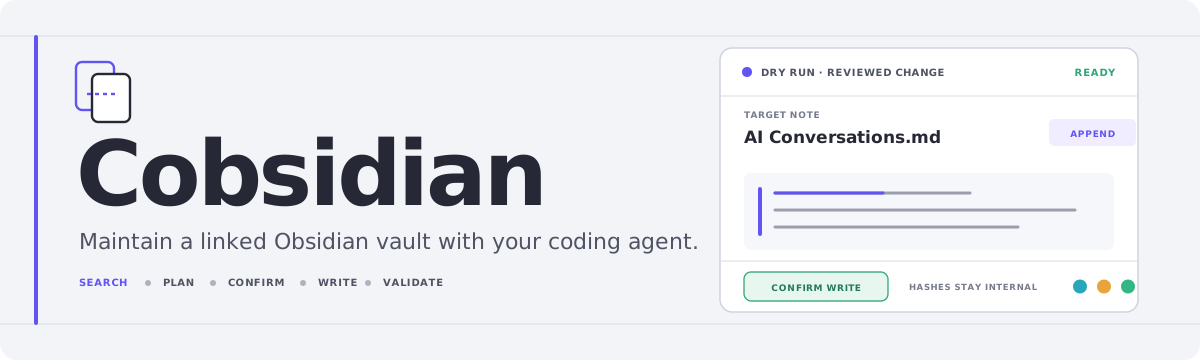





Turn AI conversations into linked Obsidian knowledge, safely.
Cobsidian is an agent-agnostic workflow skill for maintaining an Obsidian or Markdown vault. It searches before creating, previews the proposed change, asks for one plain-language confirmation, writes atomically, and validates the result. Integrity hashes stay in the execution layer; users do not copy confirmation codes.
It is not a hosted service or an Obsidian plugin. Your coding agent runs the workflow against a local folder of Markdown files.
Quick Start · How It Works · Install · DeepSeek Harness · MCP Server · Compatibility · Latest Release
Use the agent you already know: Claude Code · Codex CLI · GitHub Copilot CLI · Kimi Code · OpenCode · Pi · Antigravity
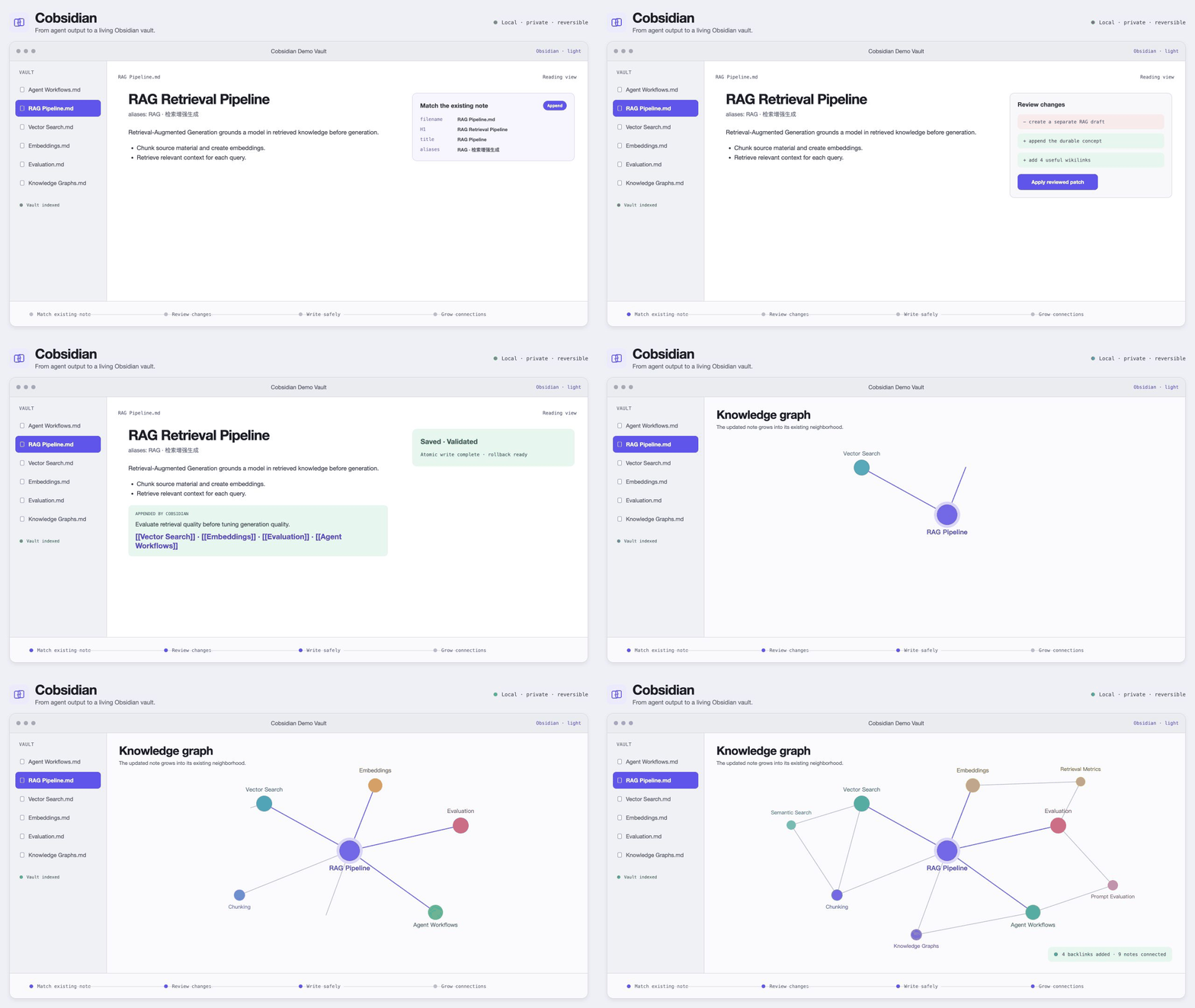
Synthetic demo vault. No private notes, paths, or credentials.
Quick Start
Run a read-only dry run against the bundled demo vault:
git clone https://github.com/Totoro-qaq/Cobsidian.git
cd Cobsidian
python skills/cobsidian/scripts/dry_run.py examples/demo-vault --topic "AI Conversations" --mode learning --text "agent workflow notes" --json
Then point your agent at skills/cobsidian/SKILL.md:
Use Cobsidian to organize this material into my Obsidian vault.
Vault: /absolute/path/to/obsidian-vault
Run a dry run first, check duplicates, suggest backlinks, and wait for confirmation before writing.
What Cobsidian Does
| Stage | What Cobsidian makes visible |
|---|---|
| Read | Resolves the vault and builds identities from filenames, H1s, titles, and aliases. |
| Decide | Reports `create |
| Review | Returns duplicate risk, backlink suggestions, and an exact patch plan. |
| Approve | Asks Apply this reviewed change?; the selected plan ID stays internal. |
| Write | Verifies the internal plan and file hashes, writes atomically, validates, and keeps rollback available. |
The result is durable Markdown with useful [[wiki links]], not a second copy of a note that already exists.
Before / After
flowchart LR
    A["AI chat, logs, project notes"] --> B["Cobsidian dry run"]
    B --> C["Search existing vault notes"]
    C --> D{"Machine action<br/>create | append | blocked"}
    D --> E["Note plan<br/>single-note | multi-note | report-only<br/>split = multi-note"]
    E --> F["Patch preview + simple approval"]
    F --> G["Atomic write + validation"]
    G --> H["Rollbackable transaction"]
| Before | After |
|---|---|
| Useful answers disappear in chat history | Reusable notes stay in the vault |
| Repeated prompts create near-duplicates | Existing identities are checked first |
| Links are guessed while writing | Backlinks come from actual vault notes |
| Agent edits are hard to audit | A reviewed, integrity-bound plan precedes every write |
How It Works
search → dry run → review the diff → confirm write → atomic apply → validate
The confirmation is intentionally human: Apply this reviewed change? On approval, the host passes the exact plan ID associated with that preview to the deterministic writer. The ID, target fingerprint, and before/after SHA-256 values remain internal integrity checks.
- You never need to read, copy, or type a hash.
- Approval applies only to the single change just displayed.
- If the target note or proposed content changes, the old approval becomes invalid and Cobsidian asks again.
- If several previews are pending, Cobsidian identifies them by target and summary instead of guessing which hash you meant.
Dry-run Preview
Dry run is the default safe path. It reports the decision and leaves writes empty.
{
  "dry_run": true,
  "mode": "learning",
  "decision": {
    "action": "append",
    "target_note": "AI Conversations.md"
  },
  "suggested_backlinks": [
    {
      "title": "Agent Workflows",
      "path": "Agent Workflows.md"
    }
  ],
  "writes": []
}
Not Just Markdown Generation
| Ordinary Markdown generation | Cobsidian |
|---|---|
| Produces a standalone file | Maintains a linked knowledge system |
| Ignores existing notes | Scans the vault before writing |
| Mixes action and document shape | Separates machine action from note plan |
| Writes immediately | Plans, confirms, writes, validates, and can roll back |
Knowledge Read / 整理判读
Before writing, Cobsidian computes a Knowledge Read: mode, depth, granularity, evidence, and display choice. auto | always | off controls conversational presentation only. With off, display_style is hidden while the complete JSON remains available in dry-run output.
Capability-based degradation keeps the result honest. A local host can become ready after checks, MCP remains read-only, and a chat-only host returns a draft or requests a usable path instead of claiming work it could not perform. Detailed rules live in the mode and host references and the shared preflight contract.
Compact Knowledge Read
{
  "mode": "learning",
  "mode_explicit": true,
  "recommended_modes": [],
  "depth": "standard",
  "granularity": "single-note",
  "evidence": "conversation",
  "display_policy": "auto",
  "display_style": "compact"
}
Expanded Knowledge Read
{
  "mode": "dissection",
  "mode_explicit": false,
  "recommended_modes": [],
  "depth": "deep",
  "granularity": "multi-note",
  "evidence": "source-grounded",
  "display_policy": "auto",
  "display_style": "expanded"
}
Obsidian Vault Workflow
flowchart TD
    U["User material"] --> R["Resolve vault path or config"]
    R --> S["Build identities and scan the vault"]
    S --> A{"Machine action<br/>create | append | blocked"}
    A --> P["Note plan<br/>single-note | multi-note | report-only<br/>split = multi-note"]
    P --> L["Suggest backlinks"]
    L --> X["Preview patch + confirm reviewed change"]
    X --> V["Atomic write, validate, rollback on new warnings"]
    V --> O["Report transaction, links, validation"]
Install
Requirements: Git, Python 3.10+, a Markdown vault, and a coding agent that can read local instructions and run commands.
Preview the destinations, then install the skill for supported CLIs:
python install_cobsidian.py --host all --scope user --dry-run --json
python install_cobsidian.py --host all --scope user
Or copy the shared skill manually:
mkdir -p ~/.agents/skills
cp -r skills/cobsidian ~/.agents/skills/cobsidian
See INSTALL.md for Windows, project-scoped, symlink, update, and uninstall instructions. See Integrations for host discovery paths.
DeepSeek Harness Cordis Bundle
Cobsidian remains an Agent Skill. The optional DSH Cordis Bundle packages that same canonical skill and Python backend as a native DeepSeek Harness extension, adding typed tools and one-shot approval without changing the existing Skill, CLI, or MCP paths.
cd integrations/dsh
npm install
npm run build
dsh plugin --profile web add .

export COBSIDIAN_VAULT="/absolute/path/to/obsidian-vault"
dsh web
The native workflow exposes scan, dry-run, prepare, apply, and rollback as separate tools. DSH presents a one-shot approval while carrying the exact plan/transaction ID in the background; users do not paste hashes. Private note material is passed through permission-restricted temporary files rather than process arguments; the bundle stores plans under ~/.dsh/cobsidian by default and does not store API keys or tokens.
The bundle currently targets the DSH 0.1.0-rc.6 API family because DeepSeek Harness is still a developer preview. See the bundle guide for configuration, use, and verification.
MCP Server
Hosts with Model Context Protocol support can run Cobsidian as a local, read-only stdio server:
python -m pip install -r requirements-mcp.txt
python skills/cobsidian/mcp_server.py
Configure COBSIDIAN_CONFIG or COBSIDIAN_VAULT; see MCP Server.
Agent Usage
Give the agent the workflow, the vault, and the safety boundary:
Use Cobsidian to turn this conversation into an Obsidian learning note.
Check whether it should create a new note or append to an existing one.
Add useful wiki links, report possible duplicates, and wait before writing.
Copy-ready variants live in Prompt Examples.
Modes
Cobsidian accepts an explicit mode or routes from natural language. Clear requests use one inferred mode; ambiguous requests recommend at most two relevant modes. See Modes and the detailed mode references.
CLI Utilities
Deterministic helpers cover vault scanning, duplicate detection, backlink suggestions, validation, dry runs, transaction preparation, exact-plan application, and quality evaluation:
python skills/cobsidian/scripts/scan_vault.py /path/to/vault --json
python skills/cobsidian/scripts/find_duplicates.py /path/to/vault
python skills/cobsidian/scripts/suggest_backlinks.py /path/to/vault --file draft.md
python skills/cobsidian/scripts/validate_notes.py /path/to/vault
python skills/cobsidian/scripts/write_executor.py prepare /path/to/vault --action append --target-note "RAG.md" --content-file draft.md --plan-out /tmp/cobsidian-plan.json
python skills/cobsidian/scripts/write_executor.py apply /path/to/vault --plan /tmp/cobsidian-plan.json --confirm PLAN_ID --json
Optional Config
cobsidian.config.example.yml is the current supported config surface. It covers the vault path, mode directories, Knowledge Read presentation, backlink limit, duplicate threshold, append preference, and validation behavior.
interaction:
  knowledge_read: auto
Copy it to cobsidian.config.yml; helper scripts accept --config cobsidian.config.yml.
Features
- Deterministic title and alias identity matching, including prefix-free core titles.
- CJK bigrams and trigrams for related-phrase matching.
- Missing wiki-link and similar-title validation.
- Paginated local MCP tools for inspection and dry-run planning.
- Integrity-hashed patches with human confirmation, internal exact-plan binding, atomic writes, and rollback.
- Public quality evaluation for duplicate, backlink, append-target, and mode accuracy.
Roadmap
- Semantic duplicate detection beyond title identity.
- Larger labeled-vault benchmarks for backlink ranking.
- Optional note templates and configurable naming rules.
- Optional Obsidian plugin integration after the workflow stabilizes.
Contributing
Contributions are welcome. Read CONTRIBUTING.md, and never include private vault content, local profile paths, API keys, unpublished notes, or personal screenshots.
Trademark And Affiliation Notice
Cobsidian is an independent open-source project. OpenAI, Codex, Obsidian, Claude, Cursor, Hermes, and other names are trademarks of their respective owners. This project is not affiliated with, endorsed by, or sponsored by those owners.
License
MIT © 2026 Totoro.
프로젝트 파일 및 신호
표시된 항목은 디렉터리 스냅샷에서 감지된 공개 저장소 신호입니다.
저장소 정보
- 언어
- Python
- 라이선스
- MIT
- 최신 릴리스
- v0.8.1
- 마지막 업데이트
- 2026. 8. 17. 오전 11:46
신중하게 설치하기
소스 코드, 권한, 수명 주기 스크립트, 의존성 및 네트워크 접근을 검토하고 신뢰하지 않는 플러그인은 격리 환경에서 테스트하세요.