설치
npx -y @deepseek-ai/dsh plugin --profile web add github:Viger1/dsh-design이 설치 명령은 GitHub 저장소 주소에서 생성된 확인되지 않은 시작점입니다.
README
유지 관리자가 작성한 문서 스냅샷입니다.
dsh-design
English | 中文
The only thing in this ecosystem that measures design rules on a rendered page.
Design tooling here splits into two buckets, and both leave the same hole. Generators produce a design and stop. Prompt-only skills hand the model a list of rules with nothing checking whether it followed them. Static analyzers parse CSS files, which cannot see what the browser actually painted: alpha composited over the real backdrop, utility classes after they resolve, a runtime theme switch, or the tap-target box as laid out.
dsh-design renders the page and measures it. "It looks good" becomes a number you can argue with — including the specific tells of a generated-looking page, which no other plugin checks at all: violet gradients caught by hue angle rather than a string match, emoji standing in for iconography, and type that fell back to the browser default because no family was ever chosen.
Same brief, two agents
One brief — a pricing page for a small API-monitoring product, Chinese UI, single self-contained index.html. Two runs on the same model and the same harness. The only difference is whether this plugin was doing anything.
| Without the plugin | With the skill + audit loop |
|---|---|
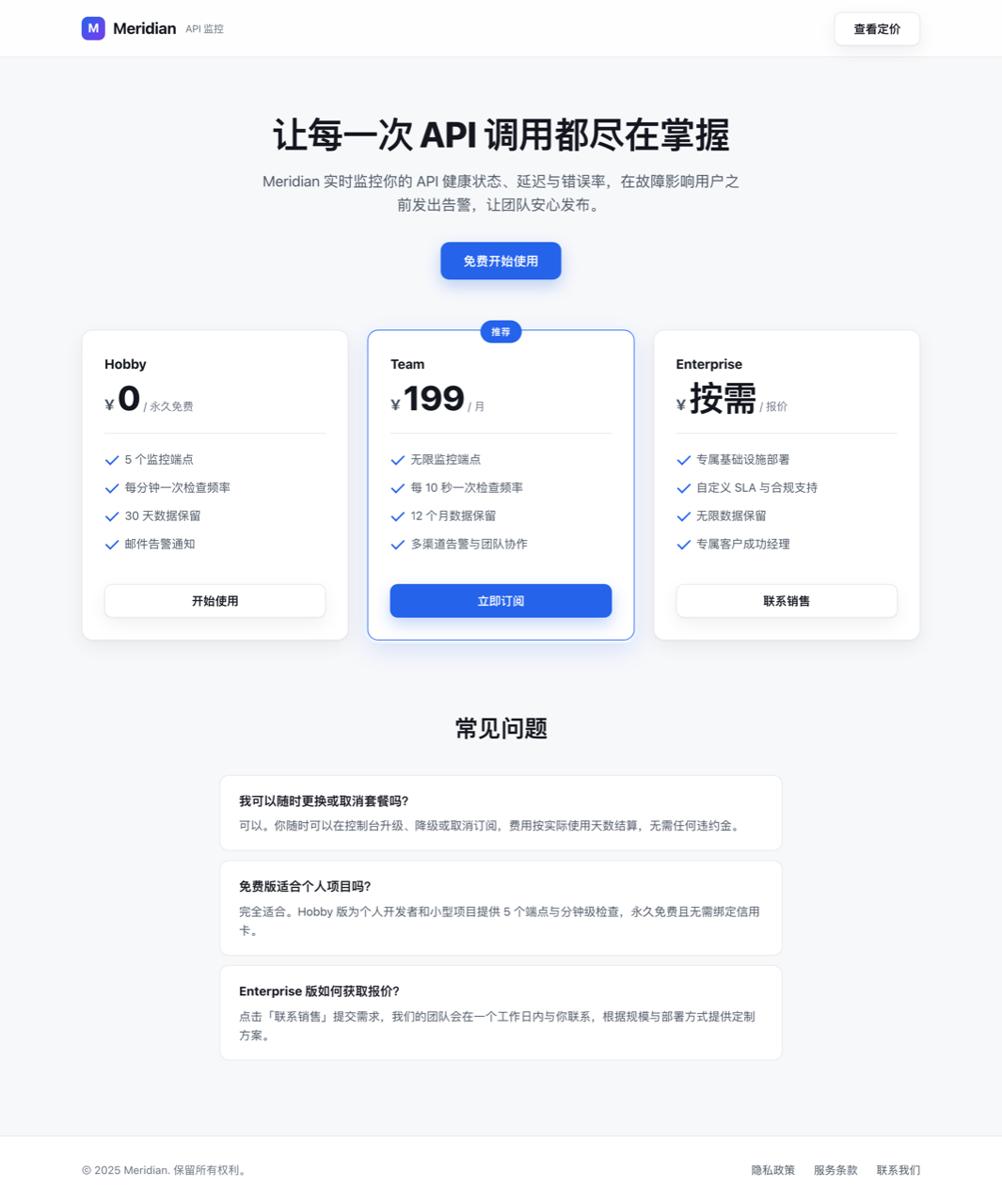 |  |
| Measured at 1280px | Without | With |
|---|---|---|
| Violations | 4 | 0 |
| Distinct type sizes | 11 — 12 13 14 15 16 17 19 20 30 44 46 | 6 — 14 16 20 24 32 40 |
| Off-grid spacing values | 10 — 5 6 10 13 14 15 18 26 30 226 | 0 |
| Tap targets under 24px | 3 | 0 |
| Generated-design tells | 1 — a violet gradient on the logo mark | 0 |
| Non-neutral colors | 3 | 5 |
| Elements sampled | 71 | 78 |
The baseline is not bad work. It is competent, and that is the point: it is the centered-blue-SaaS page you have already seen several hundred times, and it reached for a violet gradient unprompted — the exact tell the purple-gradient rule exists to catch. Underneath the competence it is improvising, with eleven type sizes and ten spacing values that belong to no scale.
The guided run committed first — one warm neutral ramp, a single deep green used only for the primary action and the recommended tier, six sizes, spacing on 4px — then audited. Round one found one violation (footer links at 22.4px tall); round two came back clean across 78 elements. Note the palette went up, 3 colors to 5: the limits are ceilings, not targets, and a page with a point of view spends its budget on purpose.
Reproduce it yourself: the brief and both outputs are in examples/pricing-page/. One run of each, so treat this as an illustration of the difference rather than a benchmark.
What it measures
| Rule | What it reports |
|---|---|
contrast | Every text element failing WCAG AA, with its measured ratio and the ratio it needed. Text alpha is composited against the real backdrop, so faded grey-on-white is caught. |
type-scale | How many distinct text sizes the page actually rendered, and which. More than a handful means the hierarchy was improvised. |
spacing-grid | Padding, margin, and gap values that miss the spacing scale, listed by value and element. |
palette | Distinct non-neutral colors. A grey ramp is free; nine accents is drift. |
tap-target | Interactive elements below the 44px floor, with their measured size. |
line-length | Running text past the comfortable measure, with the longest line found. |
default-font | Whether most text fell back to the browser default, meaning no family was ever chosen. |
purple-gradient | Violet-to-fuchsia gradients, detected by hue rather than by string — Tailwind's violet-500 sits at 258°, so a naive 260° band would miss the most common offender. |
emoji-icons | Emoji standing in for iconography inside controls. |
Findings name the element and the number. p.muted at 1.62:1 (needs 4.5:1) is actionable; "improve contrast" is not.
Measuring the rendered page is what makes several of these possible at all. Contrast is computed after compositing the text color over the backdrop the collector actually resolved, so faded grey-on-white is caught and white-on-dark-gradient is correctly left alone — neither is visible to a CSS parser. Tap targets are read as laid-out boxes, not declared sizes.
The other half: the skill
Measuring only catches drift from a system you already decided on. The bundled design-system skill is how the agent decides one — and it is written around the actual cause of generated-looking UI, which is not bad taste but unlimited choice: a fresh hex per element, a new size whenever something should look bigger, whatever margin the moment suggested.
So the skill front-loads the constraints: commit to one direction, fix the palette and type scale before writing components, lead with hierarchy, space on a scale, then audit. It ends with the concrete tells to avoid, and tells the agent to run design_audit before claiming the work is done.
Install
dsh plugin --profile web add dsh-design
Uses your installed Chrome or Edge; otherwise npx playwright install chromium once and set browserChannels: [chromium]. Requires Node ^22.19 || >=24.
Use
design_audit { target: "http://localhost:3000/pricing" }
design_audit { target: "dist/index.html", viewportWidth: 390 }
Takes a URL (localhost always allowed) or a local HTML file. Pass viewportWidth to measure a breakpoint — mobile is where tap targets and line length usually fail.
Configuration
- id: design
  name: dsh-design
  config:
    headless: true
    browserChannels: [chrome, msedge, chromium]
    viewportWidth: 1280
    viewportHeight: 900
    navigationTimeoutMs: 15000
    spacingBasePx: 4        # spacing must be a multiple of this
    maxTypeSizes: 6         # distinct font sizes before the hierarchy is unplanned
    maxPaletteColors: 8     # distinct non-neutral colors before it is drift
    neutralSaturation: 0.15 # saturation below which a color counts as neutral
    minTapTargetPx: 24     # WCAG 2.2 AA; raise to 44 for a touch-first product
    maxCharsPerLine: 75
    allowedHosts: []        # extra hostnames the audit may load
    registerSkill: true
Every threshold is a deployment choice, because a dense operator console and a marketing page do not want the same limits.
Design notes
- The browser measures, Node decides. The in-page collector only gathers computed styles; every rule is a pure function over that snapshot, which is why the thresholds, the WCAG math, and the cliche detection are unit-tested without a browser.
- Unmodelled color syntax is skipped, not guessed. A page using
oklch()loses those elements from the contrast count rather than getting a fabricated ratio. - Contrast resolves a real backdrop. The collector walks ancestors to the first opaque background, because a ratio against
rgba(0,0,0,0)is meaningless. - Neutrals are excluded from the palette count. A grey ramp is structure; saturated colors are choices, and only choices should be rationed.
Calibrated against a real application
Auditing dsh's own Web UI — a professionally designed product — was the check that mattered, because every earlier fixture had been written to trigger the rules. Two thresholds passed cleanly on it (4 type sizes against a limit of 6, five non-neutral colors against eight), which is the evidence that those limits are not arbitrary. Two rules were wrong and were fixed:
- Hairlines are not rhythm. 1px and 2px values are borders, focus rings, and optical nudges; holding them to the spacing scale was noise. Values below the base are now exempt, and when every off-grid value fits a finer scale the report says so and names it rather than asking a consistent project to abandon its own system.
- 44px is the touch guideline, not the AA bar. Flagging 28x28 desktop icon buttons applied a mobile standard to a mouse interface. The default is now WCAG 2.2 AA (2.5.8, 24px); touch-first deployments raise it.
On that same UI the report went from three violations to two, and the one that remained — two muted labels at 3.55:1 — is a real accessibility finding.
What the plugin's own review changed
dsh-review audited this source and found six defects, all fixed. The one that mattered: the backdrop walk used to treat a gradient as "nothing painted here" and fall through to white, so white text on a dark gradient hero — the most common landing-page pattern there is — was reported as a contrast failure that did not exist. A linter that cries wolf on the commonest layout gets switched off, so this was the difference between a useful tool and a liability. The backdrop now reports "unmeasurable" and those elements are skipped, holding to the same rule the foreground path already followed: measure it or say nothing.
The others: unparsed color syntax in a background is now skipped rather than assumed white; local targets are canonicalized and confined to the workspace and to HTML files, because the renderer executes what it loads; cancellation is observed across the browser launch, not only after it; the host policy is re-checked after redirects; and ancestor opacity: 0 no longer counts as visible.
Known limitations
- Measures one viewport per call; run it again at a mobile width rather than assuming.
- Samples the first 400 visible elements, enough for a page and not for an entire app shell.
- Line length is estimated from an average glyph advance, so treat it as a signal rather than a typographic measurement.
- It judges what is measurable. A layout can pass every rule and still be awkward — pair it with dsh-preview so the agent can look at the page too.
Family
| Plugin | What it gives your agent |
|---|---|
| dsh-preview | 👁 Eyes — verify what it builds: open, read, screenshot, self-check |
| dsh-pilot | ✋ Hands — operate any page by accessibility refs, with a native permission model |
| dsh-review | 🔍 Judgement — find defects, then try to refute each one before reporting it |
| dsh-design (this repo) | 🎨 Taste — constrain the choices, then measure whether the result kept them |
License
MIT © Viger1
프로젝트 파일 및 신호
표시된 항목은 디렉터리 스냅샷에서 감지된 공개 저장소 신호입니다.
저장소 정보
- 언어
- TypeScript
- 라이선스
- MIT
- 마지막 업데이트
- 2026. 8. 17. PM 3:32
신중하게 설치하기
소스 코드, 권한, 수명 주기 스크립트, 의존성 및 네트워크 접근을 검토하고 신뢰하지 않는 플러그인은 격리 환경에서 테스트하세요.