Installation
npx -y @deepseek-ai/dsh plugin --profile web add github:gordonlu/dsh-context-lensThis installation command is an unverified starting point generated from the GitHub repository address.
README
Maintainer-authored documentation snapshot.
dsh-context-lens
Request Context Profiler for DeepSeek Harness — see what changed between model requests, and how cache reuse changed with it.
What it is
dsh-context-lens is a DeepSeek Harness plugin (server unit + client view) that answers one question continuously: "what did the harness send the model this time, and what changed since the last request?" It is a pure observer — it reads the session log, adds nothing to it, and never touches a model call.
Quick start
dsh plugin --profile web add dsh-context-lens
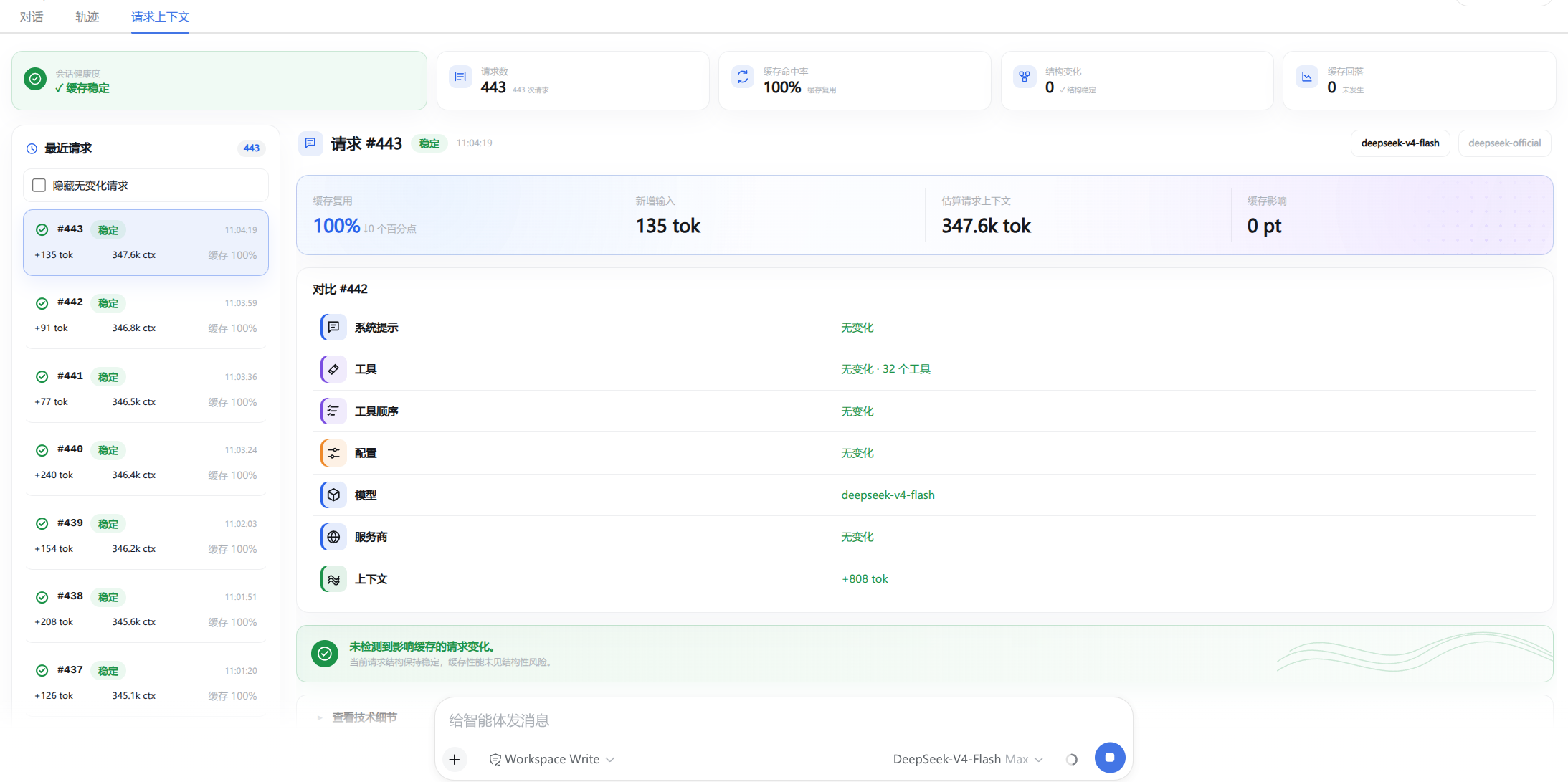
Open any conversation, switch to the Request Context tab, and watch every model request get one line: what changed vs the previous request, and how cache reuse moved with it.
For every real LLM request it records one compact card:
- Request identity — turn:step, provider, model, context window, status (completed / failed / aborted).
- The committed request context — canonical fingerprints of the system prompt, the tool set (each tool's schema hash + estimated tokens), the request config, and the tool declaration order. Only state actually committed to a real model request is compared; the harness's mutable state is never observed.
- Cache reuse readout — computed strictly from the provider's disjoint usage buckets (uncached input + cache reads + cache writes = billed input). Missing fields stay absent (rendered
-), never zero. - Diff vs the previous request — model, provider, config, system prompt, tool set (+added/−removed/~modified), tool order, estimated surface delta, and the cache-reuse boundary in percentage points.
- Drop alarm — when reuse dropped across the threshold, a ranked list of coincident changes (correlation, never causation) with an explicit disclaimer.
The view is change-first (a conversation.view slot, zh/en). Opening it answers "is anything wrong, and where?" in one glance:
- a session status strip — ✓ cache stable / ✓ structure stable / analyzed count, flipping to ⚠ alarm counts on anomalies;
- the recent-requests list, newest first (up to 100 retained), one line per request — a session-global ordinal, a change tag (Stable / Cache drop / Tools changed / System changed / +X tok), the cache readout, and a "hide unchanged requests" filter on by default;
- the inspector — cache reuse with its delta, new uncached input, estimated context surface, a line-by-line comparison vs the previous request (system / tools / tool order / config / model / provider), and a green conclusion when nothing is cache-impacting;
- raw usage buckets, header hashes, and the full tool list behind a "technical details" fold.
Accuracy boundaries
Everything on the left is genuinely observable; nothing on the right is ever claimed.
| Can determine | Cannot determine (and never claims) |
|---|---|
| System prompt, tool set, tool schemas, declaration order, request config — as committed to the request | The provider's internal cache key construction |
| Model and provider of each request | The exact token at which prefix reuse breaks (KV-causality) |
| Provider-reported usage buckets (uncached input / cache reads / cache writes / output / reasoning) | Which single change caused a drop — only correlation |
| Reuse ratio and its delta between consecutive requests | Cache state of sessions/requests that left the 100-entry window |
| A heuristic surface estimate (chars/4 + per-block + per-role overhead) | Anything about the harness's in-memory state |
Architecture
Server — one pure, replayable projection (contextLens) folds the session log: request/header events (epoch-logged, committed only on change) define the snapshot in force at each step/start; a header landing inside the step replaces it (that is the header the provider actually saw). step/end marks the span closed; finalization happens at turn/end for the last step, at the next step/start for intermediate steps, and crash-orphaned logs close as failed. Retries do not mint new records (mainline retries inside the same step; the fold also splits cleanly if a future mainline opens a fresh turn). Uninteresting events return the same state reference — the registry's zero-work Object.is gate.
Replay consistency is a tested invariant: folding the log incrementally (live) and folding the same log from init (replay) produce identical state and projection.
Client — registers the context-lens entry (order 30) in the conversation.view slot, reads the projection through the framework's useProjection('contextLens') seat, and ships its own zh/en locale namespace. Selection is component-local. No heavy UI dependencies; CSS Modules compiled with lightningcss and injected as one idempotent <style> tag.
Zero overhead — no new session events, no model tools, no prompt injection, no KV simulation. A no-op companion plugin (context-lens-invariant) exists solely to reserve the package name under the harness's invariants service.
Install & build
The plugin is an npm package with a single runtime dependency (zod); all @deepseek-ai/* references are type-only. Install it into a harness profile:
dsh plugin --profile web add dsh-context-lens
Developing from source: the published npm snapshot of the harness packages is incomplete (@deepseek-ai/dsh-compact and @deepseek-ai/dsh-type-meta are referenced but never published, and pnpm ≥ 10/11 auto-installs peers), so this repo vendors type-only copies of the nine @deepseek-ai/dsh-* packages under vendor-stubs/ (dev-time, lib/types snapshots with sanitized package.json; only dsh-llm carries a 3-line runtime for its brand constructors). @deepseek-ai/cordis installs for real. See IMPLEMENTATION_NOTES.md → "npm snapshot gaps" for the full story.
pnpm install
pnpm typecheck   # tsc --noEmit
pnpm test        # vitest — 63 tests: fingerprint, cache math, diffing, projection lifecycle, step/end, replay consistency, formatting, determinism
pnpm build       # tsc declarations → lib/types, tsdown → lib/index.js + lib/invariant.js + lib/client.js (browser, closure-factory ABI)
The browser bundle replicates the harness client-bundle ABI: window.__ModuleLoader__.load({ id: "dsh-context-lens", factory: (require) => … }), resolving react / react-dom / platform module-table entries through the loader-injected require and inlining everything else.
Real-runtime smoke scripts live in smoke/ (see smoke/README.md): a server-side smoke over the real harness packages, a client-loader ABI smoke, and a full GUI E2E against a second web instance with a mock LLM.
Layout
src/                 server: types, fingerprint, cache, diff, projection, index; companion invariant
src/client/          the conversation view + locales + CSS Modules
tests/               vitest specs incl. the replay-consistency suite
smoke/               real-runtime smokes: server, client ABI, GUI E2E
vendor-stubs/        type-only vendored snapshots of the @deepseek-ai/dsh-* packages
cordis.patch.yml     dsh bundle patch metadata
Roadmap
- Retained-window cursor to inspect older requests than 100.
- Correlation drill-down: group drops by (model, provider, tool-set hash) across the window.
- Distinguish session-level counters from the retained window in the status strip (a drop at #127 must not read as "recent 100 are clean").
License
MIT
Project files and signals
Shown items are public repository signals detected in the directory snapshot.
Repository information
- Language
- TypeScript
- License
- MIT
- Latest release
- v0.2.2
- Last updated
- Aug 14, 2026, 8:26 AM
Install deliberately
Review source code, permissions, lifecycle hooks, dependencies and network access. Test untrusted plugins in an isolated environment.