Installation
npx -y @deepseek-ai/dsh plugin --profile web add github:MJorgin/dsh-skill-routerThis installation command is an unverified starting point generated from the GitHub repository address.
README
Maintainer-authored documentation snapshot.
🍸→⚙️ dsh-skill-router
Rule-first pre-step skill routing for DeepSeek Harness: pours matched skills, stays silent when unsure.







Companion executor to skill-bartender: the skill carries the policy judgment, this plugin carries the execution. Deterministic, zero LLM calls, zero token cost until a rule actually pours:
- ⚡ Pre-step hook — reads the latest user message before every step.
- 🧭 Rule-first matching — user-editable YAML policy (
~/.dsh/skill-router.yaml, bundled defaults indefault-policy.yaml), first match wins. - 🔇 Silent miss — no hit → zero intervention; the model keeps its normal catalog flow.
- ♻️ Once per session — each skill pours at most once.
- 🛡️ Broken YAML never breaks the session — falls back to bundled defaults.
Why · How it works · What you get · Quick start · See it in action · Policy · Tested · Scope & non-goals · FAQ · Layout · License
🤔 Why
Most skill loading is left to the model's judgment: it sees the catalog every step, re-decides every time, and often loads late, wrong, or not at all. A router that runs before the model answers fixes that:
| dsh-skill-router | LLM-judge router | Manual loading | |
|---|---|---|---|
| Decision maker | rules (deterministic) | LLM / embeddings | the model, per step |
| Token cost | zero until a rule pours | every step | every step |
| Latency added | ~0 ms | model round-trip | n/a |
| Reproducible | ✅ same message → same pour | ❌ varies | ❌ varies |
| User control | edit YAML, done | prompt it | hope it remembers |
Why rules and not an LLM judge? Speed, cost, and predictability. A
URL-path rule routes feishu.cn/x/docx/ to lark-doc in microseconds, for
free, every time — and skill-bartender's routing table is where the policy
judgment lives. This plugin is the muscle, not the brain.
⚙️ How it works
- Hooks
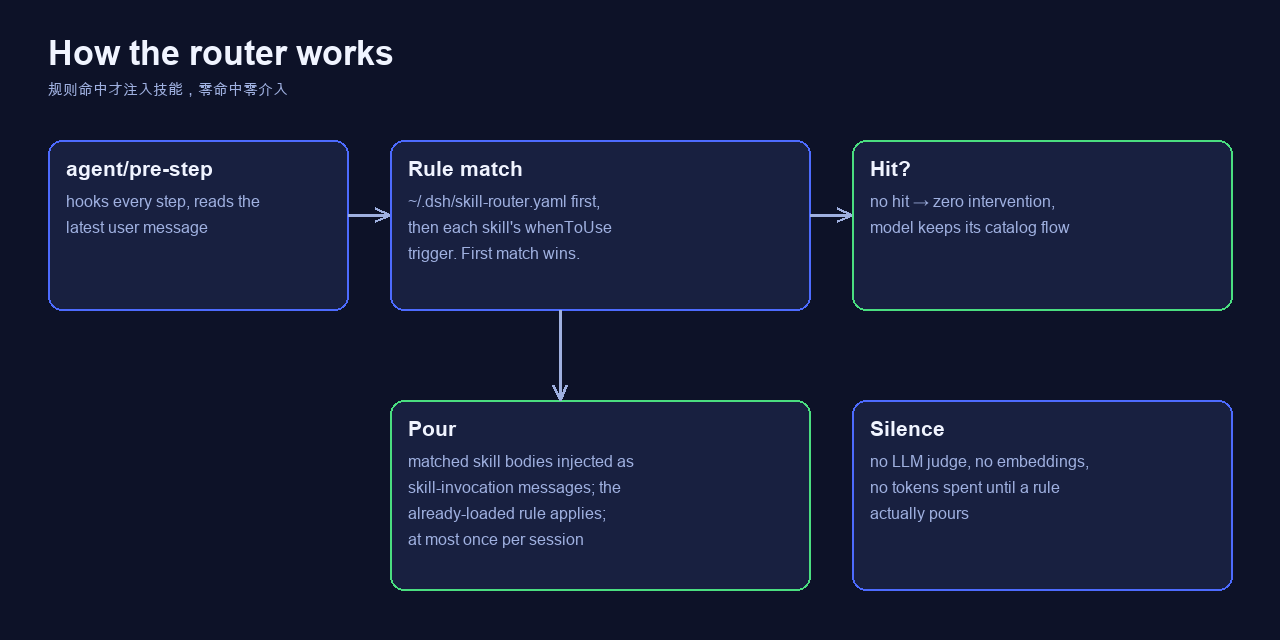
agent/pre-step, reads the latest user message. - Matches it against user-editable rules (
~/.dsh/skill-router.yaml, bundled defaults indefault-policy.yaml). First match wins. - On a hit: pours the matched skill bodies into the step as
skill-invocationmessages — the catalog's "already loaded, don't re-load" rule applies automatically. - No hit: zero intervention. The model keeps its normal catalog flow.
- Each skill pours at most once per session.
✨ What you get
| Capability | What it does |
|---|---|
| ⚡ Pre-step hook | agent/pre-step — the pour happens before the model starts thinking |
| 🧭 YAML policy | User-editable ~/.dsh/skill-router.yaml; broken YAML falls back to bundled defaults |
🔎 whenToUse triggers | Installed skills' whenToUse frontmatter acts as a secondary trigger (literal phrase match, appended after YAML rules) |
| 🚀 Zero cost | No LLM judge, no embeddings — rules only (fast, free, deterministic) |
| ♻️ Once per session | Dedupes pours per session; no skill body floods the context |
| 🔗 Companion | Works with skill-bartender's routing table and taste test |
⚡ Quick start
dsh plugin --profile web add github:akqwpeter-prog/dsh-skill-router
Then restart the running instance (profile bundles load at boot).
Verify: say "生成一张海报" — media-tools pours automatically; say "这个截图帮我检查一下" — vision-review pours. No rules matched? The model just works as usual.
📸 See it in action
One picture: a rule hits → the skill pours before the model answers; no hit → total silence.
🧭 Policy
# ~/.dsh/skill-router.yaml
rules:
  - match: "(生成|画).{0,12}(图|海报|banner)"
    pour: [media-tools]
- Ordered by precision: URL-path routing first, media, delegation, workflow skills before atomics.
- First matching rule wins;
pourlists the skill names to load. - Broken YAML falls back to bundled defaults and never breaks the session.
- Write it as data: improve matching by editing YAML, not code.
- Full reference: docs/POLICY.md · bundled defaults: default-policy.yaml · walkthrough: docs/EXAMPLES.md.
🧪 Tested
Integration suite (10 cases) run against a live profile: pour, dedupe,
zero-touch, reject passthrough, URL routing, mail-vs-IM disambiguation,
false-positive guards. See test/ in the repo, plus the design notes in
DESIGN.md and the gold-task list in GOLD-TASKS.md.
🎯 Scope & non-goals
- No LLM judge, no embeddings: rules only (fast, free, deterministic).
- No auto-install of missing skills: that stays in skill-bartender's quarantine → SkillSpector → human-approval flow.
- Rule table is data: improve matching by editing YAML, not code.
whenToUsefrontmatter on installed skills acts as a secondary trigger (literal phrase match, appended after YAML rules). Write it as a short trigger phrase; long prose never matches. Today's skill data mostly lacks the field — skill-bartender's taste test can backfill it.
❓ FAQ
Does it consume tokens when nothing matches? No. No hit → zero intervention, zero LLM calls. The router only reads text already in the step and runs regex rules — microseconds, free.
How is it different from skill-bartender? skill-bartender is the judgment (which skill fits, when to stay silent, how to install safely). This plugin is the execution (a deterministic pre-step hook that pours). They complement each other; the router works standalone too.
Can I use my own rules?
Yes — copy default-policy.yaml to ~/.dsh/skill-router.yaml and edit.
First match wins; broken YAML falls back to defaults.
Does it pour the same skill twice in one session? No — each skill pours at most once per session, so context never floods.
🗺️ Layout
dsh-skill-router/
├── index.js               # Cordis plugin: pre-step hook + pour logic
├── policy.js              # rule loading / matching (unit-tested)
├── default-policy.yaml    # bundled defaults (copy to ~/.dsh/skill-router.yaml)
├── test/                  # policy unit tests + integration suite
├── DESIGN.md / GOLD-TASKS.md    # design notes + gold tasks
├── docs/
│   ├── screenshots/how-it-works.png
│   ├── POLICY.md / EXAMPLES.md
│   ├── social-preview.png  # banner (regenerate via scripts/)
│   └── lang/README_ZH.md   # 简体中文
├── scripts/
│   ├── make-banner.py      # composes docs/social-preview.png
│   ├── make-diagram.py     # composes the how-it-works diagram
│   └── check-policy.mjs    # policy validation
├── cordis.patch.yml / package.json   # DSH bundle manifest
└── LICENSE (MIT)
🤝 Join the DSH plugin ecosystem
DeepSeek Harness developer preview is still in its testing phase for Harness developers; core plugins and base APIs will keep iterating. We look forward to exploring the upper limits of intelligence together with developers worldwide, on top of open-source, open, reusable, and composable infrastructure.
- dsh-plugin topic
- Quickstart
- DeepSeek Harness repo
- Policy companion: skill-bartender
This repo is tagged
dsh-pluginand listed in the awesome-dsh-plugin curated list. PRs, issues and translations are welcome.
📄 License
Project files and signals
Shown items are public repository signals detected in the directory snapshot.
Repository information
- Language
- JavaScript
- License
- MIT
- Last updated
- Aug 17, 2026, 4:11 AM
Install deliberately
Review source code, permissions, lifecycle hooks, dependencies and network access. Test untrusted plugins in an isolated environment.