Installation
npx -y @deepseek-ai/dsh plugin --profile web add github:MJorgin/skill-bartenderThis installation command is an unverified starting point generated from the GitHub repository address.
README
Maintainer-authored documentation snapshot.
🍸 skill-bartender
Mix the right skill cocktail for every task — and never pour an untasted bottle.







Your agent already sees a catalog of skill names and descriptions — but it over-pours: loads too many skills, loads the wrong ones, or misses the one workflow skill that composes the task. skill-bartender is the meta-skill that fixes the pour:
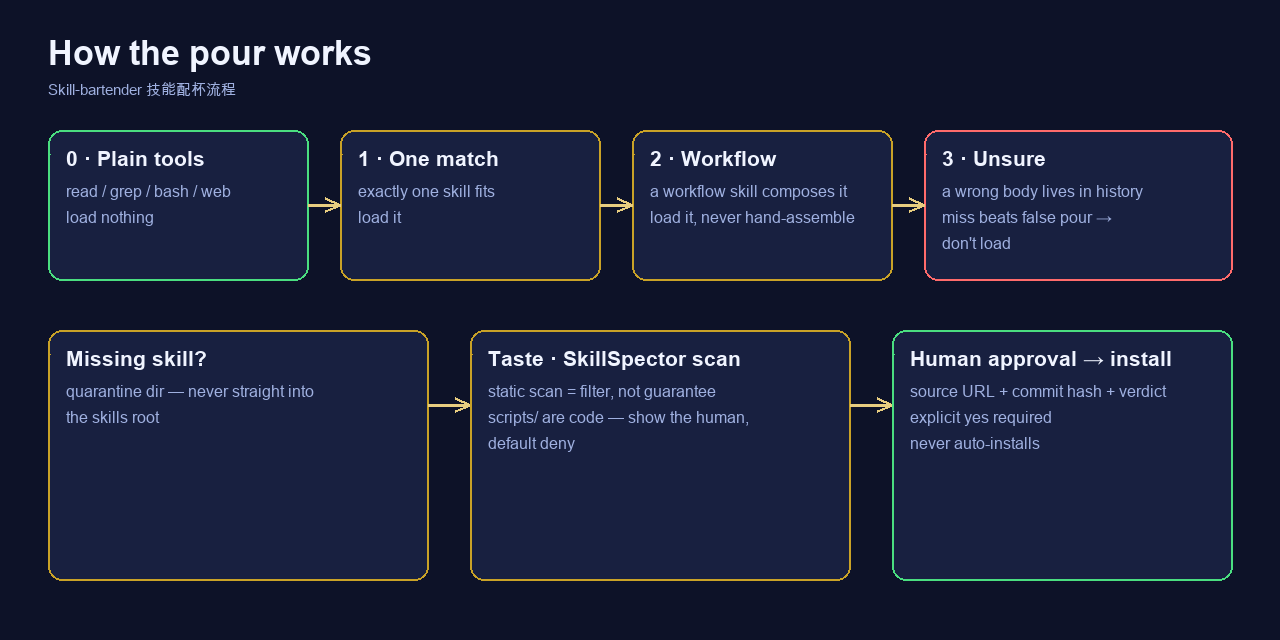
- 🪜 Laziness ladder — zero skills when plain tools suffice; one skill when one matches; workflow over hand-composed atomics; unsure → don't load.
- 🍷 Routing table — a user-editable task→skill map (
references/policy.md) that overrides the defaults. - 🔐 Safe cellar — a needed skill missing? Quarantine → SkillSpector scan → explicit human approval → install. Never auto-installs.
- 🧠 Learn — loaded-but-unused skills get logged and skipped next time.
- 🧪 Taste test — audit installed skills and rewrite weak descriptions into "when-to-use" sentences.
Why · What you get · Quick start · See it in action · Usage · Security model · FAQ · Examples · Layout · License
🤔 Why
Most agents treat the skill catalog as an all-you-can-eat buffet. skill-bartender
treats it as a bar with a taste test:
| skill-bartender | Typical catalog behavior | |
|---|---|---|
| Skills loaded per task | usually one; zero when plain tools suffice | whatever matches, however many |
| Workflow skills | ✅ preferred — never hand-assemble atomics | ❌ often missed or hand-composed |
| Unsure about a match | ❌ don't load (miss beats false pour) | ⚠️ loads "just in case" |
| Installing a missing skill | 🔐 quarantine → scan → human approval | ⚠️ downloads straight into the skills dir |
| Auto-install | ❌ never, by design | ⚠️ often silent |
| Learns from unused loads | ✅ logged, skipped next time | ❌ no memory |
Why the "laziness ladder"? A wrong skill body stays in conversation history forever; a missed load only costs one tool round-trip. The best load is the load never made (spirit: ponytail).
✨ What you get
| Capability | What it does | Where |
|---|---|---|
| 🪜 Laziness ladder | Stop at the first rung that holds: 0 no skill → 1 one skill → 2 workflow skill → 3 unsure, don't load | all platforms |
| 🍷 Routing table | Task→skill map in references/policy.md; URL-keyed families (doc/drive/wiki/sheets/base/slides) routed by path pattern | all platforms |
| 🔐 Safe cellar | Missing skill: search → quarantine dir → SkillSpector scan → scripts shown to human (default deny) → explicit yes → install; source + commit hash + verdict recorded | DSH, Claude Code, Codex |
| 🧠 Learn | Unused loads logged and skipped for the same task type next time; chronic no-shows get offered for removal | DSH |
| 🧪 Taste test | On request: list installed skills, rewrite weak descriptions into trigger-phrase form (under the 500-char catalog cap) | on request |
⚡ Quick start
One file, three platforms:
# DeepSeek Harness
mkdir -p ~/.dsh/skills/skill-bartender
cp skills/skill-bartender/SKILL.md ~/.dsh/skills/skill-bartender/
cp -r skills/skill-bartender/references ~/.dsh/skills/skill-bartender/

# Claude Code
mkdir -p ~/.claude/skills/skill-bartender
cp skills/skill-bartender/SKILL.md ~/.claude/skills/skill-bartender/

# Codex
mkdir -p ~/.codex/skills/skill-bartender
cp skills/skill-bartender/SKILL.md ~/.codex/skills/skill-bartender/
Or install as a DeepSeek Harness bundle:
dsh plugin --profile web add github:akqwpeter-prog/skill-bartender
Then say "skill-bartender" once, or paste the routing table into your AGENTS.md for always-on routing. Full examples: docs/EXAMPLES.md.
📸 See it in action
The pour flow in one picture: stop at the first rung that holds, and never install without a taste test.
🚀 Usage
Four ways to use it:
| Way | How | When |
|---|---|---|
| A. Say the name | In any session, just say "skill-bartender" | One-off or first-time setup |
| B. Always-on routing | Paste the routing table into AGENTS.md | Every task routes through the ladder |
| C. Request a pour | "Which skill fits this task?" | Choosing among skills |
| D. Cellar audit | "Audit my installed skills" | Taste test: weak descriptions get rewritten |
skill-bartender must itself be loaded once (user gesture or task match) —
it never self-triggers, and never pre-loads "just in case".
🔐 Security model (read this)
- Skills are instructions, and instructions can be adversarial (prompt injection). SkillSpector is a filter, not a guarantee.
scripts/in any skill is code — never executed without human review.- Human approval is mandatory for every install. No silent installs, ever.
- This skill scans itself clean: SkillSpector 0 findings (score 0 / SAFE) — docs/skillspector-report.json.
- Security policy: SECURITY.md.
❓ FAQ
Does it auto-install missing skills? No. Every download goes to a quarantine dir, gets scanned with SkillSpector, and is copied into the skills root only after explicit human approval. A passing scan is a filter, not a guarantee — prompt injection survives static scans, so scripts are shown to the human and default-deny.
What if SkillSpector isn't installed?
uv tool install git+https://github.com/NVIDIA/skillspector.git, or run the
manual checklist in references/policy.md.
Does it work with Claude Code and Codex? Yes — the same SKILL.md installs on all three platforms in ~15 seconds.
How is this different from DshMarket / dsh-find-plugin / dsh-plugin-autoevo? They find, search, and auto-install plugins. skill-bartender adds the routing policy (ladder + routing table) and the quarantine-then-approve discipline. Use it alongside the ecosystem, not instead of it.
How is it evaluated? The routing policy ships with a gold-task suite: docs/eval.md.
🎁 Examples
- docs/EXAMPLES.md — real routing cases, cellar installs, audits.
- docs/ROUTING-GUIDE.md — how to write your own task→skill rules.
- docs/eval.md — gold-task suite for the routing policy.
🗺️ Layout
skill-bartender/
├── skills/
│   └── skill-bartender/
│       ├── SKILL.md             # the skill itself (one file, three platforms)
│       └── references/policy.md # user-editable routing table
├── docs/
│   ├── screenshots/how-it-works.png
│   ├── eval.md                  # gold-task suite
│   ├── EXAMPLES.md / ROUTING-GUIDE.md
│   ├── skillspector-report.json # self-scan: 0 findings
│   ├── social-preview.png       # banner (regenerate via scripts/)
│   └── lang/README_ZH.md        # 简体中文
├── scripts/
│   ├── make-banner.py           # composes docs/social-preview.png
│   ├── make-diagram.py          # composes the how-it-works diagram
│   └── validate.py              # local structure validation
├── cordis.patch.yml / index.js / package.json   # DSH bundle manifest
└── LICENSE (MIT)
🤝 Join the DSH plugin ecosystem
DeepSeek Harness developer preview is still in its testing phase for Harness developers; core plugins and base APIs will keep iterating. We look forward to exploring the upper limits of intelligence together with developers worldwide, on top of open-source, open, reusable, and composable infrastructure.
- dsh-plugin topic
- Quickstart
- DeepSeek Harness repo
- Companion executor: dsh-skill-router
This repo is tagged
dsh-pluginand listed in the awesome-dsh-plugin curated list. PRs, issues and translations are welcome.
📄 License
MIT. Ponytail (MIT) is referenced, not bundled — tribute in the SKILL.md.
Project files and signals
Shown items are public repository signals detected in the directory snapshot.
Repository information
- Language
- Python
- License
- MIT
- Last updated
- Aug 17, 2026, 4:11 AM
Install deliberately
Review source code, permissions, lifecycle hooks, dependencies and network access. Test untrusted plugins in an isolated environment.