Installation
npx -y @deepseek-ai/dsh plugin --profile web add github:helloxkk/dsh-scopeThis installation command is an unverified starting point generated from the GitHub repository address.
README
Maintainer-authored documentation snapshot.
dsh-scope


English · 简体中文
Context visibility for DeepSeek Harness (dsh) — a Codex-style /context lens for every session, plus a GitHub-style usage heatmap for your whole history.
Two UI contributions, one plugin:
- Context Lens (session header) — live context-window occupancy with a segmented system / tools / messages composition bar, per-bucket session totals, and KV-cache hit rate. All data flows through the official
token-metersession projections viauseProjection— no RPC, no custom wire protocol. - Usage Heatmap (sidebar footer) — a GitHub-contribution-graph-style rolling 53-week token-usage grid. Click any day for the four token buckets, cache hit rate, session count, and per-model ranking. Fed by this plugin's own loopback-only aggregation endpoint.
Screenshots
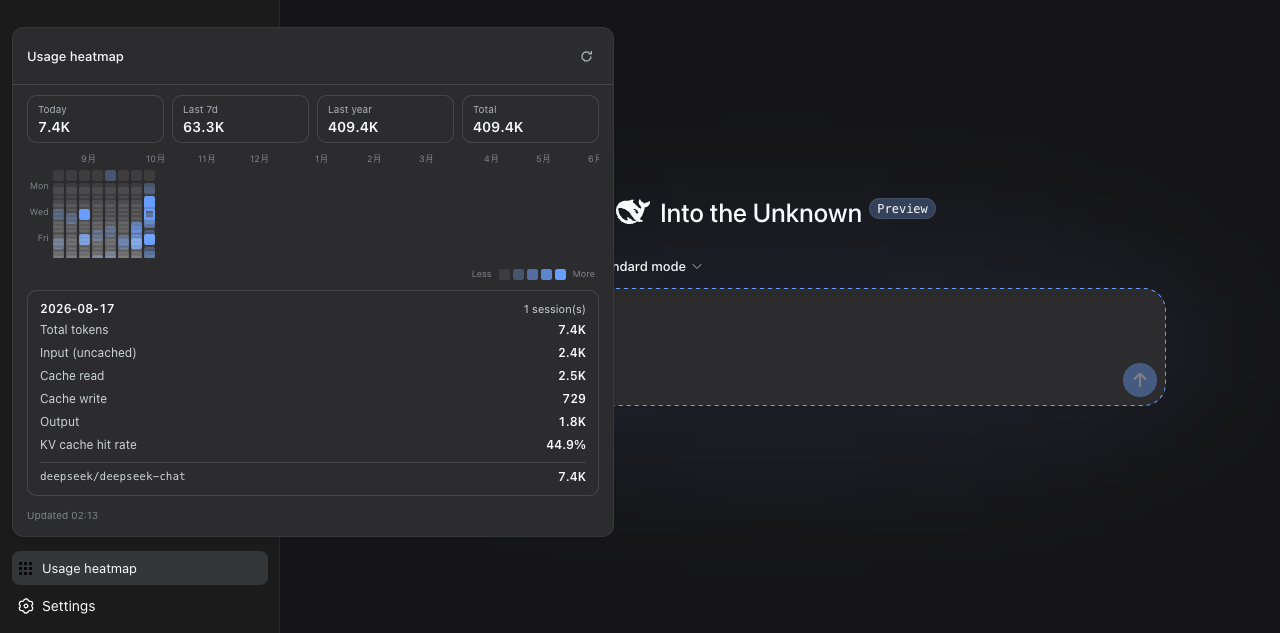
Why
DeepSeek Harness treats wording and context as first-class engineering concerns, yet the stock Web UI shows no context occupancy and no usage history. dsh-scope fills both gaps the harness-native way: reading the projections the platform already computes, styling with the platform's design tokens (--dsw-alias-*), and mounting through the platform's slot registry — light/dark themes both correct with zero media queries.
Install
Requires dsh ≥ 0.1.0-rc.6 on your PATH.
dsh plugin --profile web add dsh-scope
dsh web                             # restart dsh to load the plugin
Install from source
git clone https://github.com/helloxkk/dsh-scope.git
cd dsh-scope
npm install && npm run build
node scripts/install.mjs web        # or: node scripts/install.mjs <profile>
dsh web                             # restart dsh to load the plugin
The installer copies lib/, cordis.patch.yml, and package.json into the profile's node_modules and appends the bundle insert to the profile's cordis.patch.yml (idempotent — safe to re-run after every rebuild).
Uninstall
rm -rf ~/.dsh/profiles/web/node_modules/dsh-scope
# then remove the "# dsh-scope" block from ~/.dsh/profiles/web/cordis.patch.yml
rm -f ~/.dsh/storages/dsh-scope-cache.json   # optional: drop the fold cache
How it works
Client half (lib/client.js, loaded via the package's dsh.client declaration):
conversation.session.header.actions(order 30, after the job list) renders the lens trigger: an occupancy ring with the live percentage. The popover reads three official projections —tokenUsage(four buckets accumulated over the whole durable log),contextPressure(input-side window pressure + the route's context window), andcontextBreakdown(heuristic system/tools/message composition of the next request).sidebar.footer.actionrenders the heatmap trigger (label when the sidebar is wide, icon on the rail). The popover fetchesGET /api/dsh-scope/dayssame-origin.
Host half (lib/index.js): one read-only, loopback-fenced endpoint (/api/dsh-scope/days). Aggregation is incremental: per-session fold state is cached in memory and persisted to ~/.dsh/storages/dsh-scope-cache.json; each request folds only events added since the last fold. Live sessions fold their in-memory tail; persisted sessions use the storage backend's opaque revision and readFrom(id, fromSeq), with contiguity checks and a full refold on log rewrites. Steady-state cost stays O(new events) no matter how large the logs grow.
Fold semantics mirror dsh-token-meter's tokenUsage projection: a usage sample rides an assistant/chunk (data.chunk.type === "usage") or assistant/message (data.usage); a repeated sample for the same (turn, step) replaces the earlier value instead of double counting, re-attributed to the later event's day and model. Model attribution follows assistant/message's data.message.source, falling back to the last request/header config.
Nothing is sent anywhere: the endpoint refuses non-loopback callers and non-GET methods before any work, and no provider credentials are read.
Development
npm run build                          # tsdown: host ESM + browser ModuleLoader bundle
node scripts/fixture-session.mjs       # optional: write a demo session log with usage events
node scripts/install.mjs web && dsh web
Compatibility
Built and verified against dsh 0.1.0-rc.6 (@deepseek-ai/dsh-base / dsh-web-app bundles). The harness is in developer preview and iterates quickly — expect compatibility-breaking changes.
License
MIT
Project files and signals
Shown items are public repository signals detected in the directory snapshot.
Repository information
- Language
- JavaScript
- License
- MIT
- Last updated
- Aug 16, 2026, 6:44 PM
Install deliberately
Review source code, permissions, lifecycle hooks, dependencies and network access. Test untrusted plugins in an isolated environment.