Installation
npx -y @deepseek-ai/dsh plugin --profile web add github:Spirtxiaoqi7/mindspace-dsh-session-memoryThis installation command is an unverified starting point generated from the GitHub repository address.
README
Maintainer-authored documentation snapshot.
Mindspace Session Memory for DeepSeek Harness

An installable DeepSeek Harness community plugin for editable, session-isolated personalization memory. It keeps continuity and user control in the same place:
- a roughly 300-character profile separating confirmed user facts from AI observations, while DSH compaction stays internal;
- editable preferences and assistant instructions consolidated into at most three categorized cards each;
- a relationship identity and a purpose for each conversation;
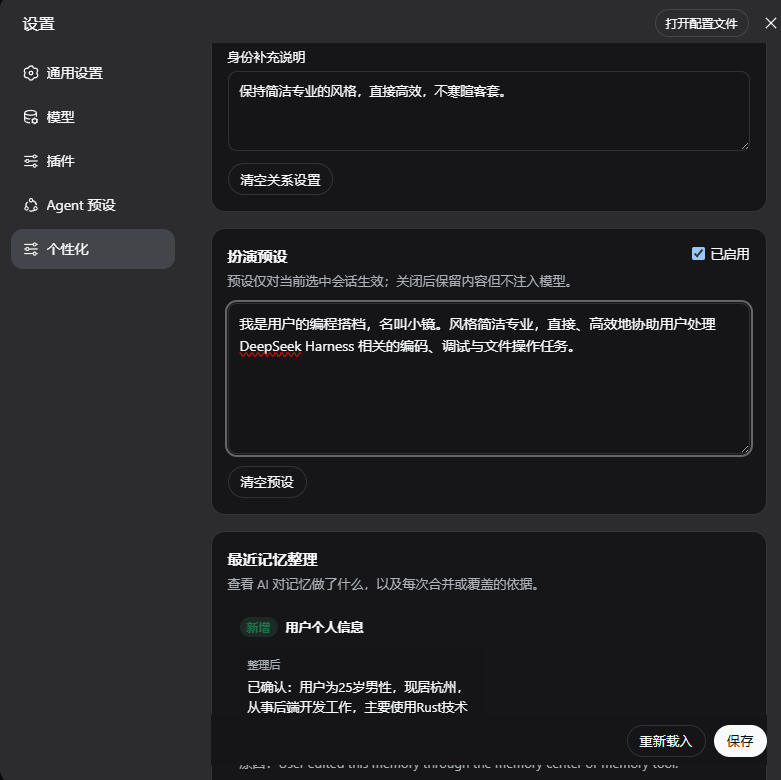
- an optional roleplay preset isolated to one session;
- model-facing
get_session_memoryandupdate_session_memorytools; - conservative automatic extraction from explicit user statements;
- category-based conflict replacement with stable card ids and a visible append/merge/replace/skip audit trail;
- a one-time, optional role/purpose/style question when a new session has no personalization.
0.2.9: Session-scoped context compaction
The Memory Center now exposes a session-isolated context-compaction policy. Users can enable it, set the trigger ratio, retained recent context, and summary limit, or run a manual compaction before the threshold is reached. The policy is persisted as session events and never changes another conversation.
- Only conversation messages are summarized; system, tool, personalization, relationship-mission, and roleplay layers are excluded.
- The prior summary is included as input to avoid losing durable context across repeated compactions.
- The compaction prompt prioritizes facts, decisions, constraints, open work, and reusable conclusions while dropping greetings, repetition, and tool logs.
- DSH remains the compaction executor; this plugin supplies the session policy and the visible user controls.
This is a community plugin and is not an official DeepSeek project. The repository artwork is supplied by the project owner and is used only to identify this repository.
0.2.0 update and contribution
Version 0.2.0 turns the first editable-memory prototype into a governed, session-scoped personalization layer for DeepSeek Harness:
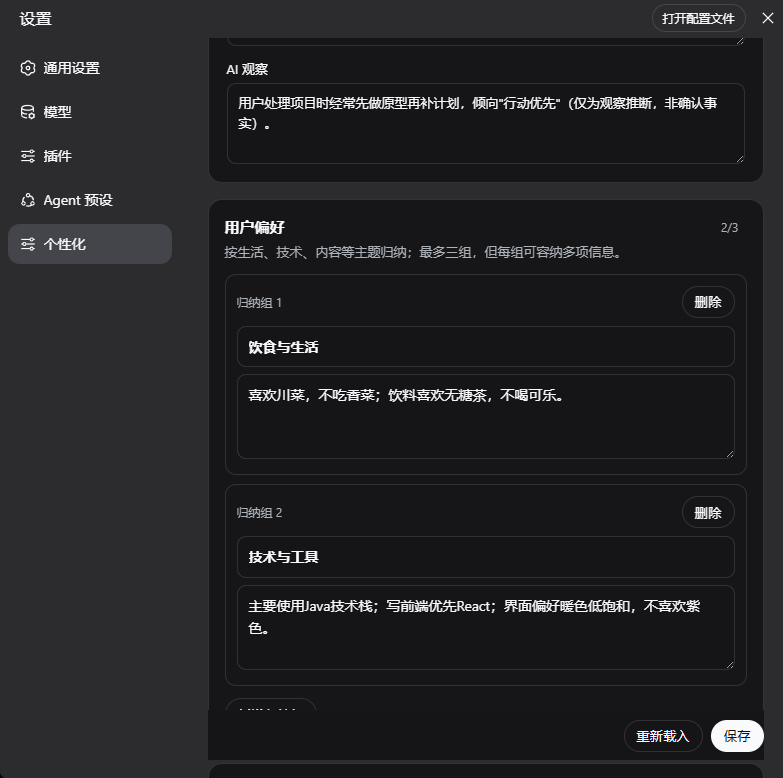
- the public compaction-summary override is replaced by a 300-character user profile that separates confirmed facts from clearly labelled AI observations;
- preferences and assistant requirements are consolidated into at most three categorized cards per section instead of growing as disconnected fragments;
- corrections replace conflicting information while preserving stable card ids;
- automatic extraction proposes a complete next state and an atom-by-atom handled/skipped ledger, so partial model output is rejected atomically;
- append, merge, replace, and skip activity records expose source message sequences, before/after values, reasons, and timestamps;
- V1 session events remain replayable and migrate into the V2 document shape;
- repeated legacy fallback categories are repaired during replay instead of locking all later writes;
- assistant names, nicknames, self-designations, and relationship-specific titles have a dedicated identity action and are never routed into the user's profile or preferences;
- relationship missions and roleplay presets remain independently scoped to each conversation.
The contribution is deliberately tree-out: one installable dual-face DSH bundle owns the Host service, event projection, prompt/tool integration, extraction hook, Typert descriptor, Remote, and settings UI. It does not replace DSH compaction semantics or require an upstream source patch, making the memory-governance layer independently installable, auditable, and removable.
Confirmed/observed profile and categorized preferences
Session role preset and visible memory audit
The V2 acceptance run passed 10 automated tests, build and package checks, real model write/merge/replace flows, cross-session isolation, and persistence after restarting the default Web profile.
Install
This README describes current main. It does not point at a nonexistent Release
tarball: build the prebuilt package from a pulled checkout, then install it from
the official Harness checkout root.
git clone https://github.com/Spirtxiaoqi7/mindspace-dsh-session-memory.git
Set-Location .\mindspace-dsh-session-memory
corepack pnpm install
corepack pnpm run build
corepack pnpm pack --pack-destination dist
$memoryTgz = (Get-ChildItem .\dist\mindspace-dsh-session-memory-*.tgz | Sort-Object LastWriteTime -Descending | Select-Object -First 1).FullName

Set-Location C:\path\to\deepseek-harness
corepack pnpm dsh plugin --profile web add $memoryTgz
corepack pnpm dsh --profile web --dump-config
corepack pnpm dsh web
Do not run pnpm dsh in the plugin directory or require a global dsh: that
command belongs to the official Harness checkout. The repository has no
install-time build script; the commands above explicitly create and install the
tarball. Historic GitHub Releases map only to their respective tags and do not
represent the current main feature set.
How it composes
The package is one DSH bundle with one dual-face row. On the Host it mounts the memory service, projection, prompt contribution, model tools, extraction hook, and Typert descriptor. The same package declares its Web client contribution, which self-mounts the generated Remote descriptor and registers the settings page.
It does not patch DSH source, api-remotes, the built-in bundles, or root TypeScript
projects. Removal is therefore one command:
corepack pnpm dsh plugin --profile web remove mindspace-dsh-session-memory
Data and model calls
Memory changes are appended to the selected DSH session event log. The UI reads and replaces a whole versioned document with optimistic revision checks. Automatic extraction is enabled by default and may make one auxiliary model request after a completed root-agent turn. A proposal must contain the complete next state plus a handled/skipped ledger for every extracted atom; invalid or partial output is rejected atomically. Confirmed facts and cautious observations remain separate, and inferred sensitive facts are rejected by policy.
Disable automatic extraction in a later profile patch if you want tool/manual writes only:
- id: mindspace-session-memory
  name: mindspace-dsh-session-memory
  config:
    maxTextBytes: 4096
    maxItemsPerSection: 3
    maxProfileCharacters: 300
    autoExtract: false
    extractionMaxTokens: 1024
Compatibility
The initial release targets the public DeepSeek Harness 0.1.0-rc family and Node
22.19+ or Node 24+. Harness is currently a developer preview; breaking upstream
changes may require a plugin update.
Recent DSH builds also ship experimental in-tree session-memory fields and a
matching settings entry. This plugin deliberately disables those in-tree rows in
its profile patch before installing its own single owner for the Remote, event
projection, prompt integration, and editable UI. Future extensions must keep one
owner per session-memory schema/Remote namespace; enabling both implementations
causes duplicate registration or competing writers.
Development
pnpm install
pnpm run build
pnpm test
pnpm pack --pack-destination dist
The generated Typert descriptors are committed under src/generated/. The build
rescopes their package identity and bundles the browser Remote with the UI.
Chinese documentation: README.zh-CN.md
License
MIT
Project files and signals
Shown items are public repository signals detected in the directory snapshot.
Repository information
- Language
- JavaScript
- License
- MIT
- Latest release
- v0.2.1
- Last updated
- Aug 17, 2026, 6:17 AM
Install deliberately
Review source code, permissions, lifecycle hooks, dependencies and network access. Test untrusted plugins in an isolated environment.