Installation
pnpm pack # -> dsh-raven-research-0.1.0.tgzThis command is generated from the GitHub repository address. Inspect the upstream README and source before running it; pin a release or commit when reproducibility matters.
README
Maintainer-authored documentation snapshot.
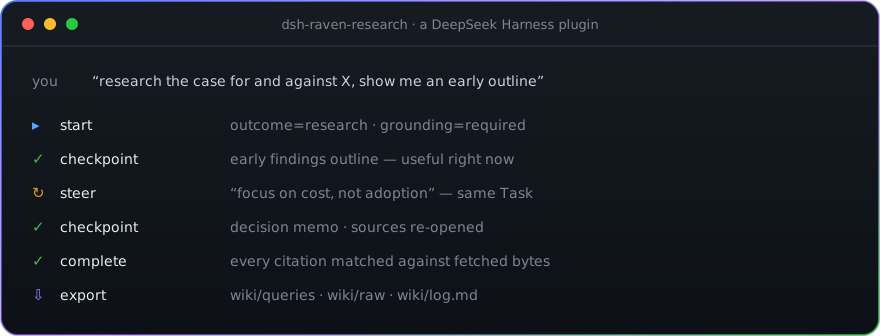
dsh-raven-research
One progressive, source-grounded Task for deep research, writing, and learning — inside DeepSeek Harness.
Early checkpoints you can steer mid-run · citations verified against the bytes actually retrieved · no second agent runtime.







English · 中文
TL;DR · Install · Usage · How it works · Configuration · FAQ
[!IMPORTANT] v1 developer preview. Pinned and tested against DeepSeek Harness
0.1.0-rc.7, which is itself an RC and ships breaking changes. Not published to npm yet — install from a checkout.
TL;DR
- What it is: a DeepSeek Harness (
dsh) plugin that adds one progressive, evidence-aware Task abstraction for deep research, general writing, academic writing, and learning. - Why it matters: you get a useful Checkpoint early, you steer it mid-run instead of restarting, and every citation is checked against the bytes actually retrieved — not against what the model remembers.
- How it is built: one host-only Cordis plugin, one model-facing
raven_tasktool, one compact prompt section. No second agent runtime, no model host, no vector store, no database. The Harness agent keeps researching and writing with its normal tools. - Install:
pnpm build && pnpm pack, add the tarball to your Harness deployment, append one row to a user-authored agent preset. See Install. - Use: talk to the Harness agent normally — no launch phrase, no separate UI. See Usage.
Why Raven
A substantial research or writing request usually disappears into a long batch pipeline: you wait, you get one wall of text, and the citations are whatever the model remembered. Raven changes the shape of that work.
| Plain long-running agent run | With Raven |
|---|---|
| Silence until a final dump | An early useful outline, draft, or findings set as a Checkpoint, then incremental refinement of the same Artifact |
| A correction restarts the work | A correction becomes a Steering Revision on the same Task; prior evidence and Checkpoints survive |
| Citations are remembered strings | Citations resolve to inspected Sources; excerpts are matched against retrieved bodies |
| Three reprints of one wire story read as three confirmations | Claims sharing a declared sourceFamily are marked as not independent corroboration |
| One dead link fails the whole run | Failed dependencies defer only the affected Claims; independently verified work still completes honestly |
| State dies with the tool call | The Task book is rebuilt from the session log and survives stop/resume |
Normal discover → read → analyze → draft → verify → refine movement stays autonomous. Raven asks only when an
unresolved choice changes the public outcome, evidence floor, audience, deliverable, significant cost, or an
external/destructive/sensitive side effect.
Features
- Progressive delivery. A Checkpoint is useful on its own and is published while the Task is still running, so you can redirect the work before the expensive part.
- Steering instead of restarts.
steerapplies a user correction to the live Task and preserves prior evidence. - Citations checked against retrieved bytes. Artifacts cite stable Source IDs with
[@source-id]. Raven matches bounded excerpts against retrieved bodies, renders recorded URLs mechanically, and rejects unknown citations, unregistered URLs, cross-host redirects, and broken or mismatched Sources. A mismatch reports the nearest retrieved passage so the anchor can be repaired instead of retried blindly. - Independence-aware Claim trace. Every Completion appends a trace mapping material Claim IDs and text to Source
IDs, marking Claims whose Sources share one
sourceFamilyso reprints of a single originating record cannot read as several confirmations. Genuinely conflicting Claims are recorded as contested rather than silently resolved. - Honest partial results. Withdrawn Claims force the asserting prose to be edited in the same Checkpoint; a dropped citation may not leave a bare assertion standing. Unverifiable evidence refuses publication rather than silently downgrading to "unchecked".
- Session-durable Task book. Works from a direct tool call and from inside a Code Mode
run_codeprogram, and survives stop/resume — see One Task book, two durability paths. - First-class settings namespace. Registering the plugin exposes
raven-researchto every configuration surface a Harness deployment composes; there is nothing to add to the Harness itself. - Durable export.
exportemits a valid llm-wiki repository — artifact page, immutableraw/source pages with verification receipts, and an appendablelog.md— that the agent writes with ordinary file tools. Raven never touches the filesystem itself.
Install
Raven is not on npm yet, so install it from a checkout. Everything below happens outside the Harness repository: you never edit a Harness checkout or a shipped preset.
Requirements
| Requirement | Version |
|---|---|
| DeepSeek Harness | 0.1.0-rc.7 (checkout 99f6f02fecdb7dff40c3fbc9470f5907c29f74ca) |
| Node.js | ^22.19.0 || >=24.0.0 |
| pnpm | 11.21.0 |
| Peer dependencies | @deepseek-ai/dsh-settings, @deepseek-ai/schemastery — supplied by the Harness deployment |
1. Build and pack
git clone https://github.com/wxxb789/dsh-raven-research.git
cd dsh-raven-research
pnpm install --frozen-lockfile
pnpm build
pnpm pack        # -> dsh-raven-research-0.1.0.tgz
2. Add the tarball to your Harness deployment
Run this from the deployment root; the package only has to be resolvable in that Node resolution graph:
pnpm add /path/to/dsh-raven-research-0.1.0.tgz
The tarball installs with no runtime dependency of its own; the deployment supplies the two peers. Once the package
is published, the equivalent dependency is dsh-raven-research@0.1.0.
3. Enable it in a user-authored agent preset
Create or copy a user-authored agent preset, then append the row from
examples/agent-row.cordis.yml to its cordis.yml:
- id: raven-research
  name: dsh-raven-research
  # Optional base layer for the raven-research settings namespace:
  # config:
  #   sourceVerification: remote
  #   sourceCheckTimeoutMs: 30000
[!WARNING] Never edit a shipped Harness preset — copy it first. Raven publishes no process service, so this row needs no isolate realm. It consumes the preset's scoped
toolsandsystemPromptregistries and obtainswebdynamically when source reopening is available.
4. Verify
Start the Harness and ask the agent for something substantive (see Usage). Raven is live when a
raven_task call appears in the transcript and a Checkpoint arrives before the final answer.
Upgrade
cd dsh-raven-research
git pull
pnpm install --frozen-lockfile
pnpm check          # lint, typecheck, test, build
pnpm pack
Then re-add the fresh tarball from the deployment root:
pnpm add /path/to/dsh-raven-research-<version>.tgz
pnpm keys a local tarball by its integrity hash, so new bytes are picked up even when the version string is
unchanged; if a deployment still serves the old build, run pnpm install --force.
Two things to check before upgrading:
- Harness pin. Compare
dshRaven.harnessVersioninpackage.jsonwith the Harness you actually run. Raven is pinned to one RC and does not claim compatibility with untested versions. - Settings.
raven-researchvalues stored in the user'ssettings.yamlsurvive the reinstall; the presetconfig:block is only the base layer.
[!WARNING] An in-flight Task lives in the session, not on disk. Finish it or
exportit before swapping the build.
Uninstall
-
Remove the
- id: raven-researchrow from your agent preset'scordis.yml. -
Remove the package from the deployment:
pnpm remove dsh-raven-research -
Optional: drop the
raven-researchsection from the user'ssettings.yaml.
Every Raven registration — the raven_task tool, the prompt section, the agent/pre-step listener, and the settings
section — is disposer-backed and owned by its Cordis fiber, so unloading removes all of it and leaves no orphaned
tool or prompt text (pnpm test:dsh exercises exactly that disposal path against a real Harness Loader). Restart
the Harness if your deployment does not reload the preset on change.
Nothing else is left behind: Raven owns no database, no cache, and no files. Task state lives in the Harness session log, and anything you exported is a plain llm-wiki repository you already own.
Usage
There is no launch phrase and no separate Raven UI — users talk to the Harness agent normally, and the model drives the Task lifecycle.
Research the strongest primary-source evidence for and against this policy. Show me
an early findings outline, keep working, and refine it into a decision memo.
Turn these notes into an 800-word essay for engineering managers. Draft early so I
can redirect the emphasis.
Develop a literature-review section from these papers. Preserve disagreement and do
not invent references.
Teach me closures with one mental model, two worked examples, and a self-check.
Steering is just the next message — "focus on cost, not adoption", "make it more sceptical", "cite only primary sources" — and it lands on the same Task instead of starting a new one.
The raven_task actions
raven_task is model-facing. These are internal lifecycle operations on one user Task, not workflows a user has to
manage:
| Action | What it does |
|---|---|
start | Opens one Task with an Outcome (research, general-writing, academic-writing, learning) and a grounding level (required, optional, none). |
checkpoint | Publishes a user-visible Artifact version with new Sources, Claims, and recorded failures, and verifies grounded evidence. |
steer | Applies a user correction to the same Task, preserving prior evidence and Checkpoints. |
complete | Validates citation identity, material Claim links, matched excerpts, Source reachability, and the exact Artifact fingerprint against the latest post-steer Checkpoint. |
status | Reports the current Task book. |
stop | Ends the Task with a recorded reason; explicitly not Completion. |
resume | Reopens a stopped Task — including an older one — without losing evidence or Artifact. |
export | Returns llm-wiki page bytes for the agent to write with ordinary file tools. |
Keeping the result after the session: llm-wiki export
After Completion, action=export returns page bytes for an llm-wiki
repository: an artifact page under wiki/queries, one immutable wiki/raw page per Source carrying the verified
excerpt and its verification receipt (capture: excerpt-only), and one appendable wiki/log.md entry. Pass
init=true to also seed SCHEMA.md, index.md, and log.md for a repository with no wiki yet. The result is a
valid llm-wiki, readable by Obsidian and by that skill's own tooling. Write the returned bytes exactly — each
raw-page digest covers its own body, so editing after export invalidates it.
How it works (under the hood)
flowchart LR
  U[User request] --> S["raven_task start"]
  S --> C1["Checkpoint<br/>early useful Artifact"]
  C1 --> ST["steer<br/>user correction"]
  ST --> C2["Checkpoint<br/>refined Artifact"]
  C2 --> V{"Source and Claim<br/>verification"}
  V -- "excerpt matches retrieved bytes" --> D["complete"]
  V -- "unknown citation / broken source" --> L["Claim deferred<br/>Limitation recorded"]
  L --> C2
  D --> E["export<br/>llm-wiki pages"]
What the plugin registers
Raven exports plain Cordis plugin metadata (name, inject = ['tools', 'systemPrompt'], a Schemastery Config,
and apply) and keeps apply thin. It registers:
- one
raven_taskmodel tool throughctx.tools; - one compact static section through
ctx.systemPrompt; - one
agent/pre-steplistener that puts the live Task book in front of the model before each step; and - the
raven-researchsettings section, gated behindctx.injectso a deployment without a settings service simply never runs that wiring.
web is deliberately not injected: it is fetched dynamically from the context when a Source has to be reopened, so
a deployment without it still loads and still writes. Every registration returns a disposer owned by the calling
fiber, which is what makes uninstall clean.
One Task book, two durability paths
Raven keeps one Task book per session and rebuilds it from the session log rather than from storage of its own:
- A direct tool call carries the Task record as durable result metadata (
tool/result.meta, kinddsh-raven-research/task-state). - A call made inside a Code Mode
run_codeprogram is a nested sub-call with no result card, so the Harness computes no presentation metadata for it. Raven therefore publishes the same record itself as adsh-raven-research/task-statesession event.
Either path restores the book when a session resumes, so a Task advanced from inside a program is not silently lost.
The failure path carries the Task too
A failed call has to reach the model with the Task it must correct against, but the registry's own error text cannot
know a Task is open. Raven attaches a <raven_task_recovery> note through the tool-owned content finalizer — the
one hook that also runs for invalid arguments and cancellations, where the output projection never runs at all.
The verification pipeline
Grounded Checkpoints and Completion run recorded Sources through an internal SourceVerifier seam (a Harness-web
adapter in production, a deterministic adapter in tests):
- Reopen the recorded URL over the Harness
webcapability, bounded bysourceCheckTimeoutMs. - Reject a redirect that leaves the recorded source identity, so a parked or aggregated host cannot silently stand in for a citation.
- Normalize HTML presentation to text, then match the bounded excerpt literally; a mismatch reports the nearest retrieved passage instead of a bare failure.
- Treat a truncated retrieval as unverifiable, never as fabrication — a body the fetch contract cut off is a retrieval limit, not missing evidence.
- Report a per-Source timeout as unverifiable instead of holding the whole Checkpoint open.
Completion then re-checks citation identity, material Claim links, Source reachability, and the exact Artifact fingerprint, and appends the independence-aware Claim trace.
Package surface and non-goals
Raven ships as one dependency-light ESM package: one Cordis plugin, one model tool, one prompt section, a pure
TypeScript Task engine, compact same-session replay through official tool/result.meta, and one SourceVerifier
seam.
It deliberately excludes a GUI, model host, vector store, custom scheduler, general agent framework, and Raven-owned database. Long-running goals, subagents, workflows, files, and persistence remain Harness responsibilities.
Design evidence and decisions
docs/design/architecture.mddocs/adr/0001-one-task-one-tool.mddocs/adr/0002-llm-wiki-repo-format.mddocs/acceptance.mddocs/reverse-engineering/assessment.mddocs/reverse-engineering/hermes-research-skills.mddocs/reverse-engineering/hermes-r-round-references.mddocs/reverse-engineering/hermes-nana-wiki.mdCONTEXT.md
Configuration
Raven owns the raven-research settings namespace. Registering it is what exposes it: a Harness that composes a
settings provider serves the namespace to every configuration surface.
| Field | Default | Effect |
|---|---|---|
sourceVerification | remote | structural-only withholds every remote check. No Source can then be confirmed, so a Checkpoint that records Sources is refused with the policy named. Set it only where the network is genuinely out of reach. |
sourceCheckTimeoutMs | 0 | Deadline for one remote Source check, in milliseconds. 0 means no deadline. An exceeded deadline reports that one Source as unverifiable instead of holding the Checkpoint open. |
[!NOTE] No setting can lower a Task's evidence floor. Withholding checks makes evidence unverifiable, which refuses publication; it never turns unchecked Sources into confirmed ones.
The composition entry in cordis.yml is the base layer. A value stored in the user's settings.yaml overrides it
and takes effect on the next Source check, with no restart; if the settings service goes away, the composition entry
becomes authoritative again.
A browser card for this namespace is deferred: the client module system requires a dsh.client bundle in the
loader's lazy-CJS factory format, and the preset that emits it is not published outside the Harness repository.
Compatibility
Raven v1 is pinned and tested against:
- DeepSeek Harness
0.1.0-rc.7; - Harness checkout commit
99f6f02fecdb7dff40c3fbc9470f5907c29f74ca; - Node.js
^22.19.0 || >=24.0.0; and - pnpm
11.21.0.
DeepSeek Harness is currently an RC and ships breaking changes. Raven does not claim compatibility with untested Harness versions.
Development
pnpm install --frozen-lockfile
pnpm check
pnpm test:pack
The repository uses a TypeScript-first modern toolchain: TypeScript 6 for strict type checking, tsdown for ESM and
declaration builds, Vitest for unit/integration/acceptance tests, Oxlint with warnings denied, and pnpm with a
frozen lockfile and an explicit esbuild build allowlist.
Verify the real Harness Loader, prompt registry, tool registry, execution pipeline, and Cordis disposal against the intended checkout:
$env:DSH_CHECKOUT = 'Q:\repos\deepseek-harness'
pnpm test:dsh
For a release-equivalent local gate:
$env:DSH_CHECKOUT = 'Q:\repos\deepseek-harness'
pnpm check:release
Acceptance coverage
The Vitest suite covers all four Outcomes and verifies that Raven …
- exposes a useful intermediate research Artifact before final verification;
- refines the same Task after a mid-run user correction;
- proceeds through normal stages without a confirmation action;
- rejects unknown references and recorded excerpts absent from retrieved source bytes;
- reopens cited URLs before grounded Checkpoints and again at Completion;
- preserves independent results across partial source failures;
- requires Completion bytes to equal the latest post-steer Checkpoint;
- distinguishes Completion from tool/worker termination; and
- stops and resumes without losing the Task, evidence, or Artifact.
pnpm test:pack creates an isolated staging project with no lib/, links only the pinned development toolchain,
exercises the real prepack lifecycle without mutating the repository build, checks the exact six-file allowlist,
and installs the tarball with an isolated pnpm home/store in a second external consumer before import, apply, and
model-tool execution.
FAQ
Does Raven replace the Harness agent, or add another model? Neither. Raven adds one task abstraction and one tool. The existing Harness agent does the research and writing with its own tools and its own model.
Do I need a vector database, an index, or an embedding pipeline?
No. Raven has no store of its own. Sources are recorded by stable identity and reopened over the Harness web
capability when verification runs.
Does it work without web access?
Yes, for non-grounded writing and learning. Without a composed Harness web capability, external Claims are not
published as supported: they remain deferred, and a grounding-required Task with zero valid Claims stays active
rather than being labeled complete.
Does it work in Code Mode (run_code)?
Yes — see One Task book, two durability paths.
How is this different from a "deep research" pipeline? A pipeline hides its middle and hands you one final report. Raven publishes the middle as steerable Checkpoints on one continuing Task, and gates Completion on excerpt-level verification rather than on the run having finished.
Does excerpt matching prove the Claim is true? No. Raven verifies URL reachability and literal presence of the bounded excerpt after whitespace/HTML presentation normalization. Literal presence is not semantic entailment; the agent remains responsible for Claim judgment.
Is it on npm? Not yet. Build and pack from a checkout — see Install.
Which DeepSeek Harness versions are supported? Only the pinned RC listed under Compatibility.
How do I remove it cleanly? Drop one preset row and one dependency — see Uninstall. Raven leaves no database, cache, or files behind.
v1 limits
- Excerpt verification is literal, not semantic (see FAQ).
- The four Outcomes select grounding defaults and explicit prompt policy inside the existing Harness agent; Raven embeds no second model and no deterministic prose generator, so content quality remains model-dependent.
- Natural-language correction detection is performed by the Harness model using Raven's pre-step context. The plugin
supplies the deterministic same-Task
steertransition; it does not guess corrections with a rule-based text classifier. - Without a composed Harness
webcapability, external Claims stay deferred. - State is durable within the owning Harness session, including multiple stopped or completed Task identities and
later resume of an older Task. Cross-session projects, reusable corpora, and spaced-repetition storage are out of
scope;
exportis the supported way to keep work. - Raven renders progress through ordinary tool results and chat; v1 has no custom browser UI.
Contributing
Issues and pull requests are welcome. Run pnpm check before opening a PR; the release-equivalent gate is
pnpm check:release with DSH_CHECKOUT pointing at a Harness checkout.
If Raven saves you a rewrite, a ⭐ helps other DeepSeek Harness users find it — and browse
dsh-plugin for the rest of the ecosystem.
License
TL;DR · Install · Upgrade · Uninstall · Usage · How it works · FAQ
Keywords: DeepSeek Harness plugin · dsh-plugin · Cordis plugin · AI research agent · deep research · agentic research · source grounding · citation verification · evidence-based writing · academic writing assistant · learning assistant · retrieval-augmented generation · hallucination mitigation · TypeScript · Node.js
Project files and signals
Shown items are public repository signals detected in the directory snapshot.
Repository information
- Language
- TypeScript
- License
- MIT
- Last updated
- Aug 18, 2026, 4:22 PM
Install deliberately
Review source code, permissions, lifecycle hooks, dependencies and network access. Test untrusted plugins in an isolated environment.